Tamon's B-Side: The Funny, Smart, and Painfully Real Face of Being a Star

I stumbled upon this anime completely by accident on Crunchyroll, but it quickly turned out to be an absolute gem that has me laughing out loud constantly. If you think this is just another shallow story about a popular boy band and a naive girl falling in love with one of the singers—you couldn't be more wrong. Beneath the layer of excellent comedy lies surprising depth and a brilliant deconstruction of the Japanese showbiz industry.
For any fan of Japan or anyone wanting to understand the complex dynamics between a star and their fans, this is an absolute must-watch. The main character, Utage, is a textbook otaku, and her entire life revolves around Oshi culture (推し). Tamon, the lead singer of her favorite group, is her titular oshi—the idol she supports more than anyone else. Utage is fully dedicated to her oshikatsu (fan activities): she juggles multiple part-time jobs and takes on overtime just to spend every hard-earned penny on his merch. By pure coincidence, she ends up working as a housekeeper right in his apartment.
What truly strikes you in this story is the masterful clash between illusion and reality, and its perfect execution of the "Gap Moe" (ギャップ萌え) phenomenon. This term describes the charm we feel when a character reveals a side of their personality that completely contradicts their appearance or everyday behavior. On stage, Tamon is the epitome of charisma, a total seducer whose life motto is: "I want everyone to smile." Meanwhile, in the comfort of his home, he drops the mask and becomes someone else entirely. He seamlessly transitions from a dazzling god of the stage to a withdrawn, depressed "boy-failure" in sweatpants, who is terrified of people and panicked about disappointing his fans.
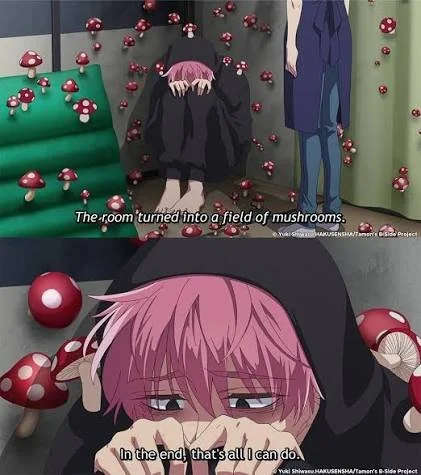
His bouts of melancholy are portrayed in the most adorable way—when doubt consumes him, mushrooms literally start growing around him. The sight of Utage taking out 20 trash bags filled with these "mushrooms of sadness" while cleaning her idol's house (whom she affectionately nicknames "Gloomy Hara") is pure comedy gold. (It also quickly becomes apparent that the other band members have equally shocking, dual personalities behind the scenes!).
The series phenomenally illustrates the eternal struggle and moral dilemma between being a fan and being just a normal teenager trying to help a lost boy, slowly morphing into his friend. In Japan, there is a strong illusion of accessibility and a golden rule of boundaries. Idols are marketed as "pure" individuals who theoretically belong to all their fans, which is why an idol getting a girlfriend is often a career-destroying scandal. Fans are absolutely not supposed to cross those boundaries.
This thin ice is perfectly summed up in what I consider the funniest scene in the series. Utage is discussing her love for her idol with her friends, when one of them casually asks: "What if our idol finds a girlfriend?" The other's response is blunt: "We'll murder her." Right after, the girls perform a ritual "witches' dance" together. It's a brilliant and very sharp satire on the real, sometimes terrifying sense of ownership that toxic fans (known as sasaengs) feel toward celebrities. Watching this, our main character breaks out in a cold sweat and starts choking with discomfort—because she is the one who dangerously crossed that invisible line of intimacy.
The most beautiful part of it all is that whenever Tamon loses his faith in himself as "Gloomy Hara," Utage doesn't cheer him up from the position of a girl in love. She does it as his most loyal otaku. She restores his almost god-like (kami) status, reminding him why he brings her so much joy when he's on stage. You watch this with a constant smile on your face and a huge appreciation for how intelligently this anime navigates the fascinating world of Japanese fandom.
Who is this anime for? I highly recommend this series to anyone who lives daily in the illusion of Instagram and the idealized world of social media, and also—perhaps especially—to kids and teenagers. It’s a fantastic, humor-filled lesson that exposes the mechanics of image-crafting. It showcases a beautiful and much-needed truth today: even the biggest star is, deep down, just a human being. A human being who struggles with their own problems, fears, and insecurities. Behind every perfect smile on a screen or in a photo hides someone who sometimes just wants to put on old sweatpants and disappear under a blanket with their "mushrooms of sadness"—and that is absolutely okay!
