Prophecy for the Age of Bryan Johnson — "Ghost in the Shell" (1995) and the Immortality Obsession
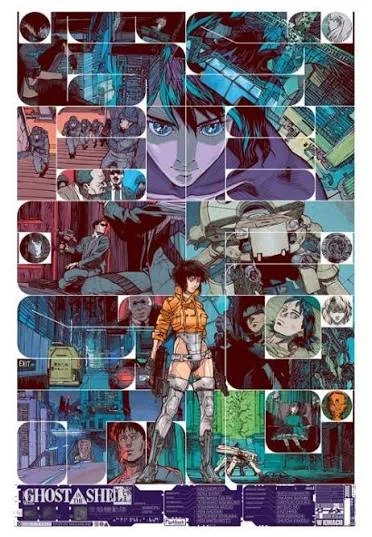
We're living in an era where the dystopian digital visions of three decades ago have stopped being science fiction and become Silicon Valley's literal roadmap. Watching Bryan Johnson today — a billionaire pouring millions into biological rejuvenation, plasma swaps, and the meticulous elimination of every weakness in his own body in pursuit of building a flawless "superhuman" — it's hard not to feel like you're watching a live-action adaptation of Mamoru Oshii's Ghost in the Shell.
This isn't just another cyborg story. The 1995 film draws deeply on Oshii's earlier, intensely personal work, Angel's Egg (1985), a poetic record of his own crisis of faith and disillusionment with the Church. In Ghost in the Shell, Oshii carries those existential questions over into the realm of technology. The question of God becomes the question of the soul (the "ghost") in a world where the body is nothing more than a swappable biochemical casing (the "shell").
How far are we willing to go — how much of ourselves are we willing to swap out — in pursuit of perfection? And what's actually left of us once we discard the body in favor of the perfect machine?
2026: When Prophecy Catches Up to Reality
The irony of this comparison took on a bitter new dimension this year. Bryan Johnson — creator of the Blueprint protocol and the face of the "Don't Die" movement — announced in July 2026 that he'd been diagnosed with an incurable autoimmune gastritis, a disease notoriously hard to detect, which had been quietly developing for years inside a body subjected to the most rigorous optimization regimen in pop-culture history. The man who once declared he didn't believe in his own death, and who not long ago predicted humanity would achieve biological immortality by 2039, had to publicly admit that his own organism — measured, scanned, and supplemented daily — had slipped out of his control.
It's a scene straight out of Ghost in the Shell: the harder we try to lock the body into a system of data and metrics, the more painfully it reminds us that it isn't a program you can fully debug. Johnson had already ended his most controversial experiment — plasma transfusions from his own son — switching to a full plasma exchange after admitting he'd seen no benefit from it. That image in particular — living, familial blood circulating between bodies in the name of survival — resonates most strongly with Batou's line about "a doll with real, living blood running through it." Johnson literally acted out Oshii's metaphor before anyone had the chance to pin it on him.
What's even more striking is that Johnson himself increasingly speaks in language that could have come straight out of the Puppet Master's mouth. "Don't Die" has stopped being just a supplement brand and become — in his own words — the seed of a new belief system, something close to a religion, complete with its own morality ("don't die" as the highest good) and its own eschatology (sequencing the "foodome," algorithmic nutrition, the body as an engineering project to be perfected without end). Where the Church that Oshii wrestled with in Angel's Egg promised salvation of the soul, Johnson promises salvation of the body. But the problem Ghost in the Shell poses is that saving the body alone, without ever asking about the ghost, might just end up saving an empty shell.
A Crisis of Faith, Transplanted into Technology
To understand how deeply Ghost in the Shell is rooted in religious questions, you have to go back to Angel's Egg — the film in which Oshii, a former theology student disillusioned with the dogmatism of Japanese Christianity, tells the story of a girl protecting a giant egg that may or may not contain something alive. The whole film is a metaphor for faith without proof: you have to care for something whose existence you can't confirm, until finally — cracked open out of desperation or curiosity — the egg turns out to be empty.
Ten years later, Oshii carries that same question from theology into computer science. If you can't prove the existence of the soul by scientific means, maybe you can at least prove a simulation of one. Major Kusanagi — a fully cybernetic body with a human brain somewhere inside — is Oshii's living egg: a shell you have to care for without ever knowing for certain whether there's anything inside beyond nerve tissue reacting to electrical impulses. Bryan Johnson, rebuilding his own body according to blood, sleep, and microbiome metrics, is asking the same question in reverse: can you optimize the shell so precisely that the spirit — if it exists — ends up trapped inside it forever, like a perfectly tailored prison?
A Doll with Living Blood
Today's cultural chase after longevity trains us to treat tissue and muscle like replaceable parts. We aim to strip everything down to what's most valuable: a clean brain and consciousness. But what actually constitutes our human identity?
Batou says a line in the film that, in an age of digital narcissism and obsessive biohacking, lands almost like a verdict:
"There's nothing sadder than a doll without a soul. Especially one with real, living blood running through it."
It's a merciless diagnosis. You can keep a fully biological, perfectly optimized body and still be nothing more than an empty mannequin run by habits and algorithms. The real danger isn't in swapping out a hand or an eye for a cybernetic prosthetic — it's in losing the spiritual spark while remaining fully biologically intact.
It's worth noting how precisely that line describes the mechanics of modern biohacking. Johnson's Blueprint is hundreds of supplements taken on a schedule, meals reduced to a standardized caloric slurry, sleep tracked to the minute, skin and organs monitored like an industrial fleet of machines. All of this happens inside a fully biological body, with blood that genuinely flows through its veins — and yet it's increasingly hard to shake the feeling that it's this very regimen, not any prosthetic, that turns a person into a doll. Habit and algorithm replace spontaneity and choice; the body gets saved, but whatever used to inhabit it is being sterilized, more and more, of the randomness that made it human in the first place.
When DNA Becomes a Program
The film's heaviest philosophical thread circles around the idea of the Puppet Master (Project 2501). This character reduces the human genetic code to pure information theory, stripping away the illusion of our uniqueness:
"One could say that DNA is nothing more than a program designed to preserve itself. Is it possible for a cybernetic brain to generate its own ghost, to create a soul all by itself? And if it can, then what does it mean to be human? Can you offer me proof of your own existence? How could you, when neither modern science nor philosophy can explain what life actually is? A human being is only an individual because of their intangible memory. Memory can't be defined, and yet it's memory that defines humanity."
The Puppet Master flags a consequence modern humans never saw coming: the accumulation of data and computerization created a parallel system of thought and memory. If DNA is nothing but a program for species survival, and memory is nothing but a data set, then the line between a purely biological human and an artificial being disappears entirely.
That line about DNA as a self-preservation program sounds almost like something pulled straight from Johnson's SXSW presentation, where he talked about the "foodome" sequencing project — mapping, at the molecular level, exactly how every nutrient affects the body, so that eating itself becomes fully algorithmic. But the difference is fundamental, and it's exactly what makes this comparison so unsettling: the Puppet Master, being a pure program, wants what a human has — nondeterministic memory, randomness, a soul. Johnson, being human, is moving in the opposite direction — he wants what a program has: predictability, repeatability, control over the very variable that biology has always treated as noise. Both movements converge on the same point, right where any clear answer to "what is life" runs out.
An Angel That Wants to Reproduce
In the film's final scene, the Puppet Master doesn't ask Major to destroy him or to run — he asks to merge with her. His argument: any system that can't diversify and multiply is doomed to die out the moment it hits one fatal bug, or one virus it has no resistance to; it needs death, chance, and offspring in order to survive as a species, not as a single copy. That's strikingly close to the language of evolutionary biology that the longevity crowd loves to borrow — except here Oshii's conclusion runs against the biohacker's intuition. The immortality of one perfectly preserved individual isn't a triumph of evolution — it's evolution's negation. A species that wants to survive has to diverge, make mistakes, and die off in countless variations at once — not freeze itself into a single "optimal" configuration.
Johnson, planning literal bodily immortality for himself, stands on the side Oshii already marked as a dead end back in 1995. The new egg born from the union of Major and the Puppet Master at the film's close isn't a copy of either of them — it's a third thing, unforeseen, capable of change. It's the most optimistic image in the entire film, and at the same time its sharpest critique of the logic of "preserve yourself flawlessly, forever."
The Trap of Perfection and Overspecialization
In an age when people are trying to biologically engineer the perfect human, Major Kusanagi's warning lands like a caution against an evolutionary dead end:
"If we all reacted the same way, we'd be predictable. And there's always more than one way to look at a situation. What's true for the group is also true for the individual. It's simple: overspecialization breeds weakness. It's a slow death."
The drive for absolute control and for engineering one single "ideal" biological template is, at bottom, an attack on your own survival. The Puppet Master himself makes the point bluntly to Major: "Your effort to remain what you are is what limits you." Johnson's July 2026 diagnosis reads like a textbook illustration of that line. An autoimmune disease is exactly a situation where the body, in its own "overspecialized" defensive precision, attacks its own tissue — a system built to protect turns into a source of harm, precisely because it does what it was tuned to do too precisely, too aggressively. It's the literal biological version of Major's warning: a mechanism dialed in for one response, however "optimal" it looks on paper, turns out to be a weakness the moment the context shifts.
Beyond One Film: The Same Warning from Every Direction
Ghost in the Shell isn't alone in this. William Gibson, in Neuromancer, described the body as "meat" — something the console finally lets you discard — and showed that the people most desperate to shed it are the ones who get lost most completely in the data they meant to master. Ridley Scott, in Blade Runner, asked whether artificially manufactured memory makes someone less real than a person born naturally — and answered no, because it's memory itself, real or implanted, that creates an attachment to life. Otomo, in Akira, showed what happens when the power of technological self-enhancement outstrips an individual's ability to psychologically hold it together. The same pattern repeats across all of these stories: technology that promises to free us from the body's limits first has to answer the question of what, exactly, we're trying to save when we discard the body. Ghost in the Shell is the most direct of them all, because instead of dodging the answer, it makes its characters say it out loud — and that's exactly what makes the film such a convenient mirror for someone like Bryan Johnson, who's now trying to prove that same answer empirically, one supplement at a time.
What's Left of the Ghost When the Shell Is Already Perfect
Real evolution isn't about desperately outrunning old age with plasma doses and biochemical discipline. As Batou puts it: "Once you start doubting, there's no end to it." But it's exactly that doubt — that intangible, immaterial memory and that unique blend of thoughts — that makes up our ghost: something no biohacker or programmer will ever manage to lock inside a perfectly optimized shell.
Thirty years after Ghost in the Shell premiered, we now have a real, living experiment confirming the film's thesis — playing out not in some fictional laboratory, but in front of millions of Netflix viewers and social-media followers. Bryan Johnson has built the most advanced version of the "shell" ever achieved outside of fiction — and it's precisely at the moment this shell is failing him biologically that we hear, loudest of all, the question Oshii has been asking for three decades: can you design a body without ever answering the question of what's supposed to live inside it? The answer the film suggests — and one that's getting harder to ignore in 2026 — is that until we face that second question, every investment in the first one is just postponing the same unresolved problem.
