“Yes Man — a Remedy for Grumpiness
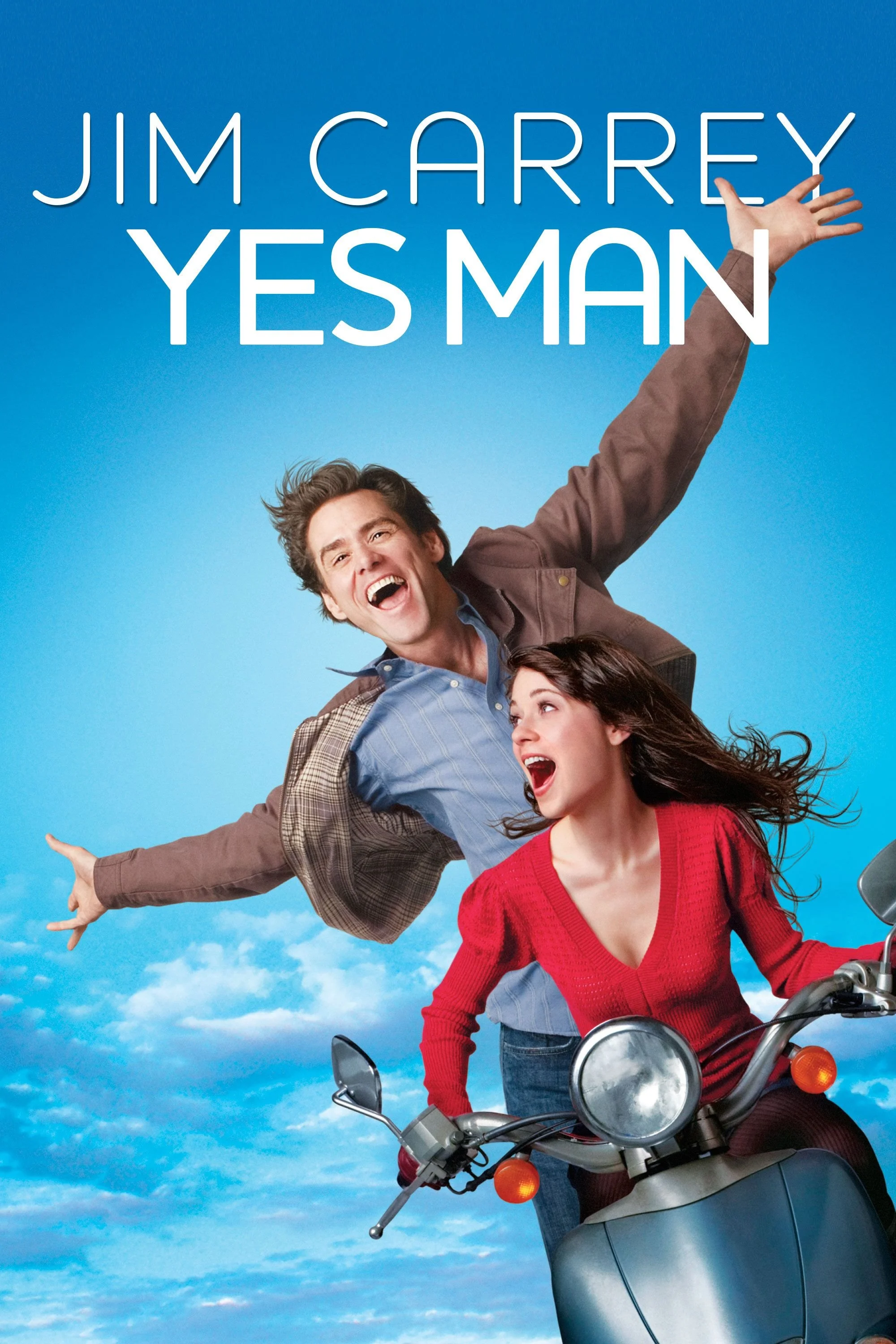
“The world’s a playground. You know that when you’re a kid, but somewhere along the way everyone forgets it.”
Whenever I feel myself slowly being swallowed by the negativity void, I know I need to do something about it. I don’t mean forcing myself to be positive or pretending everything is wonderful. It isn’t. I’m not particularly interested in affirmations in the mirror, compulsory gratitude, or turning every Monday morning into a celebration of being alive. But perception matters enormously. The same life can feel miserable or surprisingly beautiful depending on what we train ourselves to notice, what we expect to find, and how much of the world we still allow ourselves to experience.
I know this because I have two almost laboratory-perfect examples around me.
On one side, there is my bright-and-shiny husband — permanently optimistic, permanently smiling, permanently convinced that everything will somehow work out. He generally assumes people mean well and that the catastrophe I have already mapped out in an Excel sheet across four separate scenarios will probably never happen. Sometimes I need sunglasses because it is simply too much light for my realistic, down-to-earth, small Pomeranian-demon soul.* 😆
On the other side, I know someone who can find something wrong with nearly everything — rejection, disappointment, an insult, a bad intention, a reason not to go, not to try, not to bother. Even a neutral situation can eventually become another piece of evidence that the world is, once again, against them.
Negativity rarely swallows a life all at once. It is more like a patient administrator quietly crossing things off the calendar. First one outing, because it is not worth the effort. Then another, because people are exhausting. Then a phone call goes unanswered. Then an invitation already looks more like a potential disappointment than an opportunity. Eventually the world does not necessarily become worse. There is simply less and less of it left.
That is why Yes Man has always felt like a strange little remedy for grumpiness to me. And let’s be clear: this is not some profound philosophical masterpiece. It is a Jim Carrey comedy. It is ridiculous in places, genuinely stupid in others, and I probably like it more because of that. Because buried inside all the chaos is one idea that has stayed with me for years. It is not really about “yes”. It is about the automatic “no”. I’m not going. I won’t try it. I don’t know how. Not my thing. Not now. Maybe another time. After a while, you stop noticing that you are even making a decision. “No” becomes the factory setting.
Yes Man was loosely inspired by Danny Wallace’s book. After a breakup and a period of increasingly withdrawing from people, Wallace decided to run an experiment on himself: for a while, he would say “yes” to the opportunities that came his way. Not because every opportunity was brilliant. The point was to let chance back into his life. And I think chance is the part that interests me most. Not grand gestures. Not quitting your job and running away to a cabin in the mountains or, in my own “modest” case, Japan. I mean smaller disruptions to the plan: going somewhere I would normally never go, signing up for something I will probably be terrible at, talking to someone I would never have met if I had stayed home, doing something without having a sensible answer to the question: “But what is the point?” Because saying yes does not just give us new experiences. Sometimes it gives us a different perspective. You meet people who live differently from you. You discover that something you dismissed as “not for me” is actually quite fun. You realise that the version of the world you had in your head was not the only one available.
And then there is Allison, played by one of my favourites, Zooey Deschanel. She sings in a strange band with almost no audience and runs a jogging photography group for people who want to exercise and take pictures at the same time. Jogging photography. Obviously. And I love her for it. Allison seems almost completely free from the need to justify what she enjoys. She does things because she likes them, not because they are productive, impressive, useful, monetisable, or part of some five-year plan. She does not need every hobby to become a project. She just likes things. A rare species. When was the last time you did something simply because you liked it?
As the film progresses, Carl’s world expands. He meets people, ends up in places he would never otherwise have gone, and learns things that seem completely pointless at the time. And I love that the film later gives those apparently useless experiences a purpose. Learning guitar can save someone’s life. Yes, absurd. But also somehow true. You never really know which completely unnecessary thing you learn today might become useful years later. Meaning has an annoying habit of arriving after the fact.
I also love what happens at Carl’s bank. He starts approving small loans for people who probably would not normally be taken very seriously. Not huge companies with immaculate pitch decks and flawless business plans, but people with small businesses, odd ideas and plans that might look too risky, too unimpressive or simply not “bankable” enough. And for some of them, Carl is the first person who actually says: fine, I believe you. Try. That matters. Sometimes people do not need a grand act of rescue. They need one person to take them seriously before the rest of the world does. And then they repay the loans. His branch starts making money. Carl gets promoted. But my favourite part is more subtle: later in the film, the businesses and products he helped fund begin appearing quietly in the background. Those little yeses start having lives of their own. Sometimes one person believing in someone else’s idea is enough for something that might never have existed to actually enter the world.
Of course, the film also understands that automatic “yes” can be just as mindless as automatic “no”. If you agree to everything, you stop making choices too. People can use your openness for their own benefit. You can cross your own boundaries. You can end up doing things you never wanted in the first place. So the opposite extreme is not freedom either. And that is when we get the conversation that explains the function of “yes” — as if life were a maths problem, only unfortunately without one correct answer:
“So the whole yes thing is all bullshit?
— No. You just don’t know how to use it, that’s all.
— Yeah, I do. Say yes to everything. Real tough to grasp.
— No, that’s not the point. Well, maybe at first it is, but that’s just to open you up to it. To get you started. Then you’re saying yes, not because you have to, not because a covenant tells you to, but because you know in your heart that you want to.”
And I think that is the whole point. Not blindly agreeing to everything, but temporarily switching off the automatic “no, that’s not for me” filter and seeing what happens. At the beginning of the film, Carl says “no” to everything. Later, he says “yes” to everything. The word changes. The mechanism does not.
The brain is not particularly romantic about any of this. It likes patterns, predictability and anything that saves energy. Familiar responses are cheap. New ones require effort. So if we practise “no” for long enough, eventually it stops feeling like a decision. It becomes a shortcut. A default setting. That is why I think “yes” sometimes needs training too — almost like a muscle. Not because saying yes is inherently better, but because if one response becomes too dominant, eventually we stop noticing that other options were even available. Sometimes you have to deliberately make room for “yes” before your internal optimisation system decides that the most efficient version of your life is the one in which nothing unexpected ever happens.
And that is a terrifyingly efficient life. No awkward encounters. No disappointing events. No wasted evenings. No terrible beginner classes. No strange conversations. But also no surprises. No accidental discoveries. No stories. No life leaking in through the cracks.
And maybe that is the part I care about most. I do not want my own defence mechanism to quietly turn into an isolation mechanism. I do not want caution to become avoidance. I do not want realism to harden into cynicism. I do not want safety to become so comfortable that eventually there is nowhere left to go from it. So maybe Yes Man is not really about becoming more positive. Maybe it is about making sure that the brain’s very sensible desire to protect us from disappointment, wasted effort and discomfort does not accidentally protect us from living as well.
That is my version of a remedy for grumpiness. Not compulsory optimism. Not pretending bad things do not exist. Not forcing myself to be delighted by everything on principle. Just making sure I do not optimise my life so efficiently that nothing happens in it anymore.
The world may not be a playground all the time. But I really do not want to become the kind of person who sees danger in every swing, irony in every smile and the promise of disappointment in every invitation.
Maybe you’ll join my little challenge: twice a month, deliberately step outside your usual safe pattern, try something different, and say “yes” precisely when your brain is already serving you a perfectly convenient “no” on a silver platter.
So — when was the last time you turned your first “no” into a “yes”?
*Julki (yes, that is actually my name - Julka ;)) are very obscure creatures from Polish folk belief, known locally in Pomerania, particularly around Jamno and Łabusz in what is now the Koszalin area. They were described as small, benevolent underground spirits or dwarf-like beings associated with burial mounds and ancient graves. According to local tales, they mostly wanted to be left in peace, but if people respected them, they could also be helpful — even sharing their food stores during times of famine.
So when I call myself a “small Pomeranian demon”, this is what I mean. Technically, Julki were closer to benevolent folk spirits than actual demons — but “small Pomeranian demon” is much more fun. 😆
