Matcha on Monday Michiko Aoyama
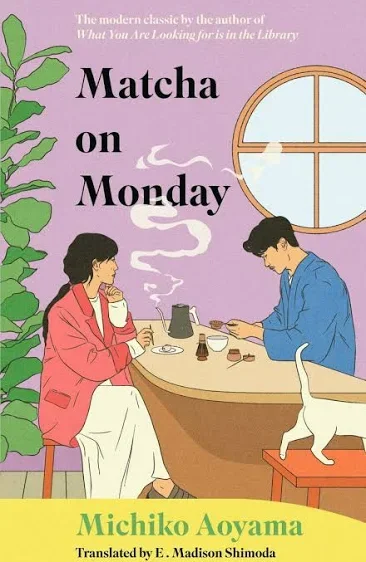
"Who am I actually addressing when I press my hands together and say in my mind: 'Let something good happen'? 'May everything work out!' I focused my attention on the place where my palms met, pressed tightly together, and I felt the warmth of my own body. Ah, so that's how it is — I direct my requests into the inside of my own hands."
Do you remember "Cocoa on Thursday” ? Marble Café is back—and it's a comeback in grand style. Let me reassure you right away: having read "Cocoa" isn't required—"Matcha on Monday" can be read completely independently, though for regulars of Marble Café, returning faces will be an extra treat. Matcha on Monday begins on the day the café is normally closed: once a month, on a Monday, it turns into a place for matcha tastings. Around this intensely green tea, Aoyama builds twelve stories for twelve months — and does it masterfully. The characters flow into one another: the hero of one story flickers in the background of the next, someone hands someone a bowl of tea, a chance conversation in one tale turns out to be the turning point of another. Nobody here is an extra — everyone carries their own story, and everyone, sometimes unknowingly, nudges someone else's forward. It's precisely this intricate weave that fills my binary heart with happiness. I read it, in fact, the way I celebrate the ritual of drinking my beloved matcha: unhurried, sip by sip, one story per sitting.
Fulfilling our desires is in our hands — literally.
My beloved, shortest story in the whole collection comes down to a single scene. The heroine presses her hands together — the way you do at a temple, the way we all do when we badly want something — and suddenly asks herself a question that floored me with its simplicity:
"Who am I actually addressing when I press my hands together and say in my mind: 'Let something good happen'? 'May everything work out!' I focused my attention on the place where my palms met, pressed tightly together, and I felt the warmth of my own body. Ah, so that's how it is — I direct my requests into the inside of my own hands."
Yes, yes, and a hundred times yes! We pray, we plead, we cross our fingers — and all that warmth we feel between our palms is our own. You don't need to go to a temple to ask for something good, because the addressee of those requests lives inside us. It's a beautiful illustration of my life's mantra: fulfilling our desires is in our hands, and we just have to get to work. Like in my beloved anime 100M, about sprinters — bend reality until it yields under our pressure. Aoyama doesn't moralise or spell it out; she serves this thought in one quiet scene, and it stays with you for a long time. The shortest story in the collection — and the most accurate one.
Japan for dessert: minazuki.
This is what I love most about Japanese "café literature": between one story and the next, you can learn something new about Japan. This time Aoyama smuggles an entire cultural lesson into a single sweet — and I'm smuggling it onward to you.
Minazuki (水無月) is the old, poetic name for June in the Japanese calendar. But it is also a traditional wagashi sweet that appears in confectioneries precisely at the end of that month — and its appearance is an important event in Japan's cultural calendar. It looks unassuming: the base is a white, slightly translucent steamed jelly made of sweet rice flour (uirō), topped with a layer of red azuki beans. And it is always, always cut into triangles.
Because nothing about minazuki is accidental:
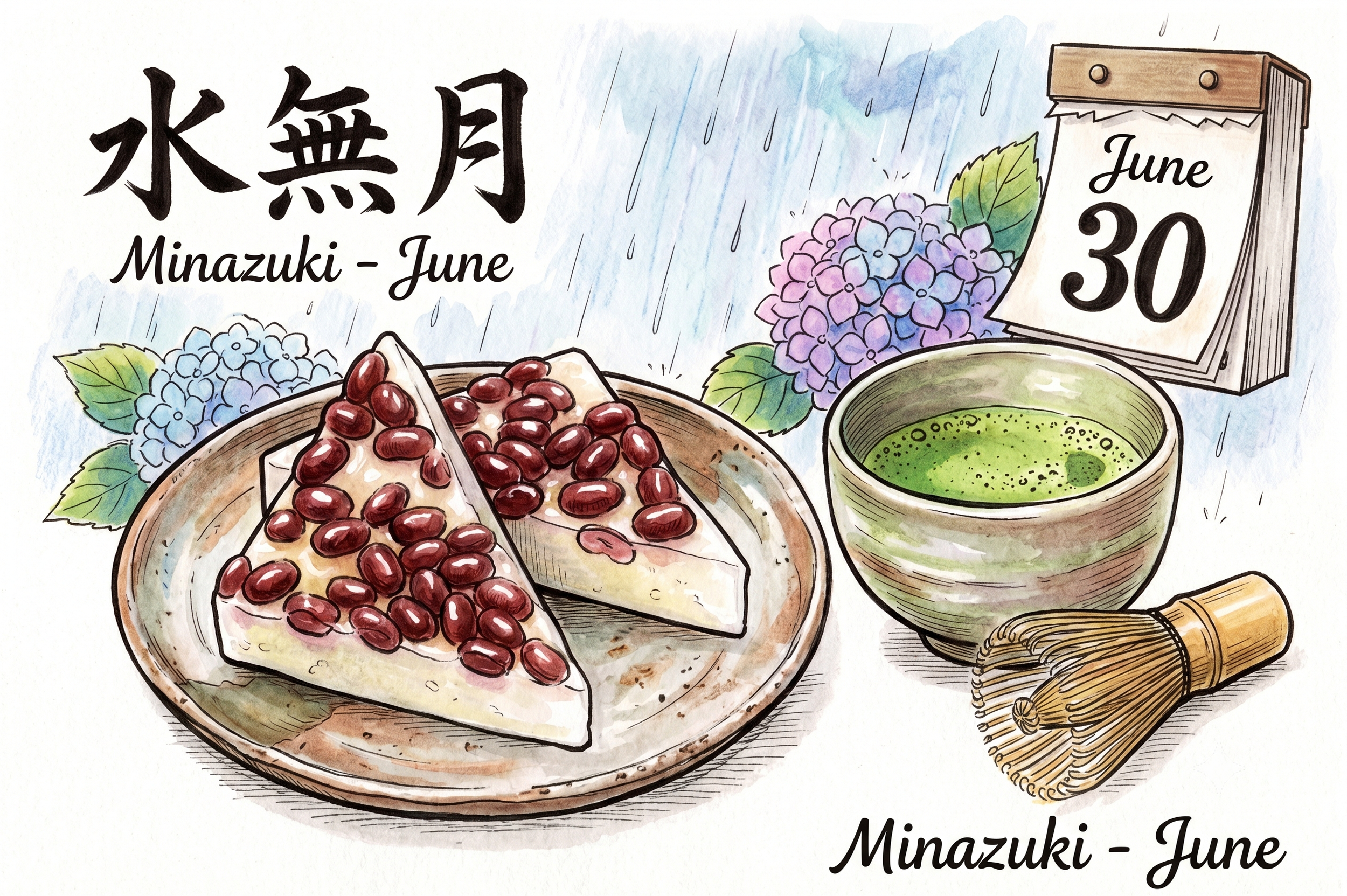
The triangular shape is meant to recall sharply pointed shards of ice — a luxury that, in the old days, only the emperor and the aristocracy could afford.
The red azuki beans carry a protective colour in Japanese folklore: red drives away evil spirits, illness and misfortune.
The date is a ritual too: minazuki is traditionally eaten on June 30th, the last day of the month, during Nagoshi no harae — the summer purification festival. It is meant to ensure health and strength to survive the humid, sweltering months still to come.
"Of course. It's called nagoshi no harae, the summer purification and warding off of misfortune. In the old days, court aristocrats would chase away the heat at the end of June by putting ice in their mouths, preparing themselves to survive the hard summer. But back then ice was a luxury, and ordinary people couldn't afford it. So they cut white rice jelly into triangles, imagining it was ice."
Ordinary people had no ice, so they invented it for themselves — out of rice flour and imagination. And several hundred years later, their "make-believe ice" is still eaten every year, on the same day, for the same purpose. Isn't that the most beautiful definition of culture?
On perspective.
I also loved the story of an unhappy teenage love and of how much it hurts to feel misunderstood among your peers. We all know it: the whole world shrinks to one classroom, one clique, one person who doesn't see us. And exactly at that moment, someone tells the heroine something seemingly banal that turns everything upside down:
"It's all because you keep looking only at them. If you turn the other way, the world will look different. And unexpectedly, all sorts of things seemed meaningless to me."
All it takes is turning around. The world has no single front — we decide which way we look and what grows in our eyes to the rank of "everything". And right after that comes a sentence that should hang above the bed of everyone who has ever compared themselves to others:
"Everyone shines in a different place and at a different time. (...) If it can't be expressed in numbers, then all the more you cannot compare and claim that something is the best and something else worse."
In a world that tries to count and rank literally everything — likes, steps, grades, reach — Aoyama reminds us that what is most precious in us cannot be counted. And if it can't be counted, it can't be compared either. End of discussion.
On memory and tending to relationships.
What charmed me most, though, was the story of a decades-long friendship built on writing letters. Two people, decades, paper and ink — a bond nurtured at a pace that today seems from another era. And a sentence that might be the most mature definition of closeness I've read in a long time:
"I think that a bond with the person destined for us is a very fragile thing — it will crumble to pieces if either side acts carelessly. You have to show the other person interest in every word addressed to them, in every passing glance. The bond will survive if we nurture it."
And I think it's worth pausing here for a while. In times when we're drowning in noise and obligations — are we really with our loved ones when we're with them? Isn't time spent together the best gift we can give? Do we truly listen to them — or just wait for our turn, scrolling in the meantime? What do we actually know about them? And even though tending to a relationship is hard, daily work — do we do it because we truly care? And why do we do it at all? Maybe simply because it makes us happy — a happiness which, as Aoyama writes, is a shape woven from a multitude of the thinnest threads: small things, each of which, though beautiful, is fragile on its own. Happiness doesn't arrive in one grand event; it is braided from small, delicate gestures that are easy to snap and must be woven again and again.
And if a relationship brings no happiness? Maybe it's worth ending the ones that leave no room for reciprocity — and Aoyama has a thought even for that, one I'm taking with me, because it strips endings of their weight of failure:
"An ending doesn't mean moving on to the next stage and that's it — you need to look at what you've done so far and accept yourself. It's also a good moment to thank those who supported us."
An ending as a moment of gratitude, not mourning. Very Japanese. Very needed.
Who would I recommend it to?
Everyone who loves intimate, interweaving stories and Japanese everyday life served by the teaspoon — and who'd like to learn something about Japan along the way, because Aoyama smuggles culture, calendar and wagashi between the lines. I especially recommend it to those who weren't swept away by Hot Chocolate on Thursday the way others were — I wasn't, I told you about it here — because the Marble Café is definitely worth a second chance.
One last thing
Matcha on Monday is, for me, a return in great style — and a reminder that we carry fate inside our own hands. Perfect for reading slowly, story by story. With a bowl of matcha, of course.
*Michiko Aoyama, „Poniedziałek z matchą", tłum. Barbara Słomka, Wydawnictwo Relacja 2026.
