Force — Kohei Nawa
Force — Kohei Nawa
Museum on Echigo-Tsumari (MonET) · Tokamachi, Niigata
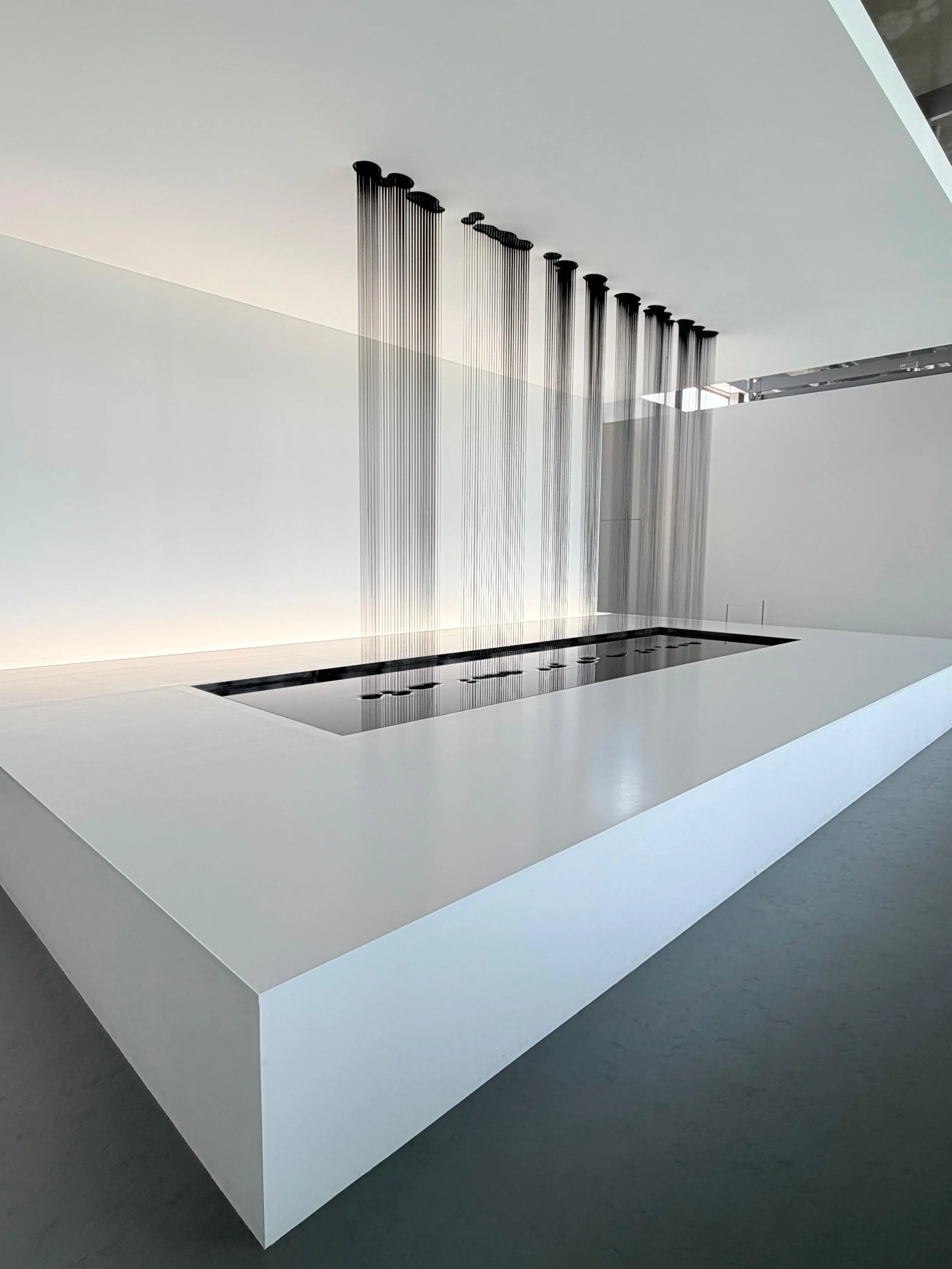
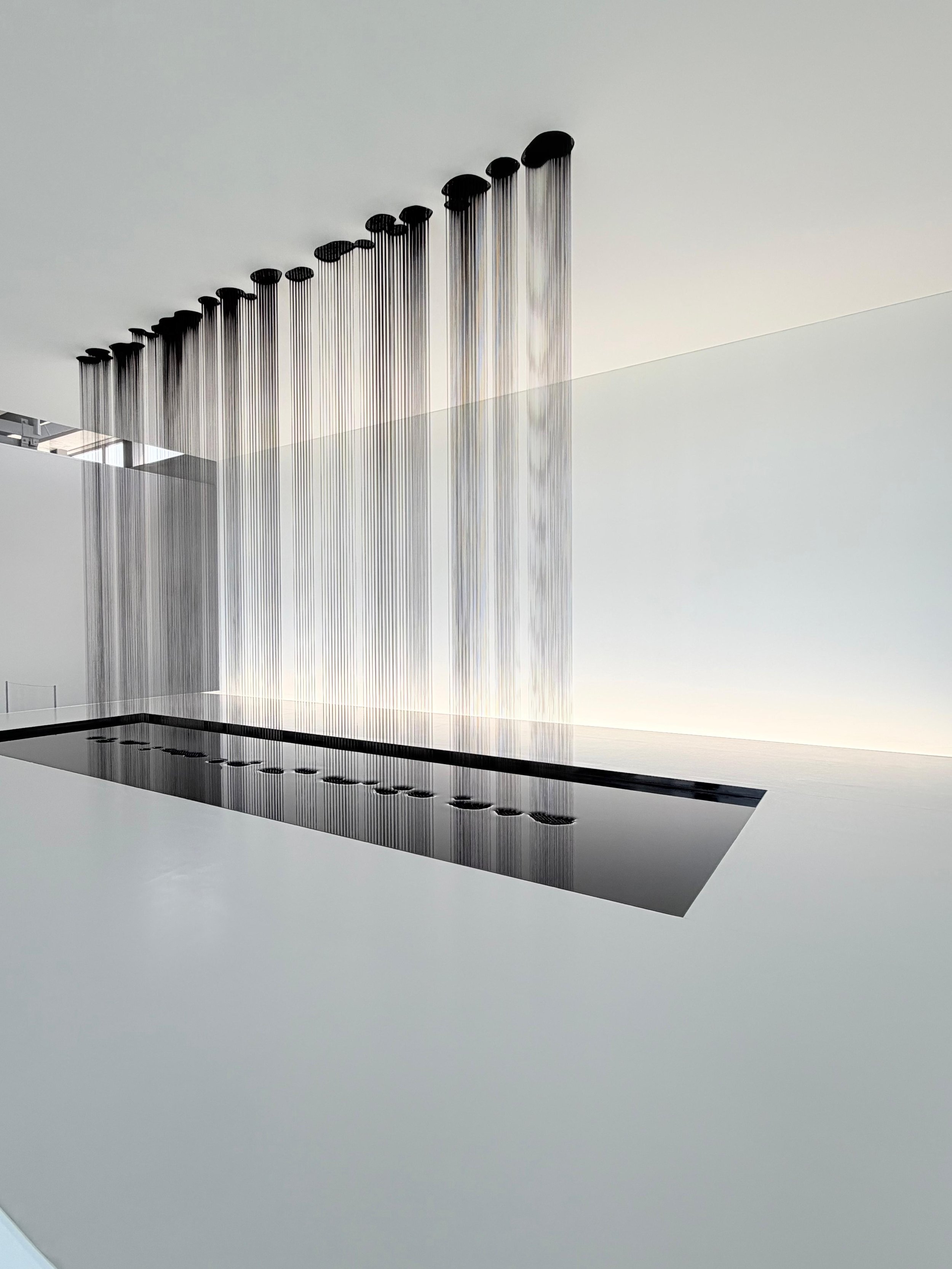
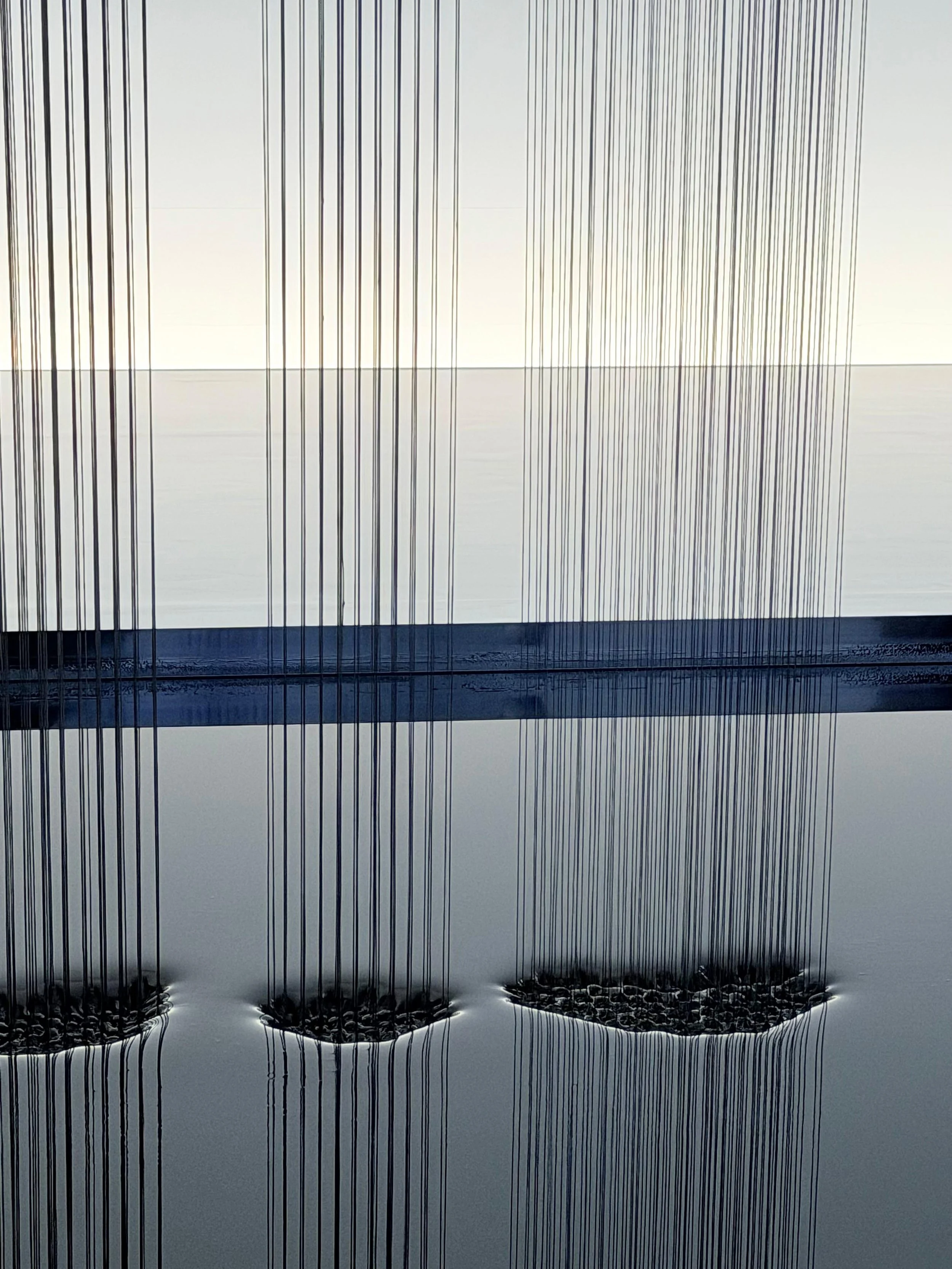
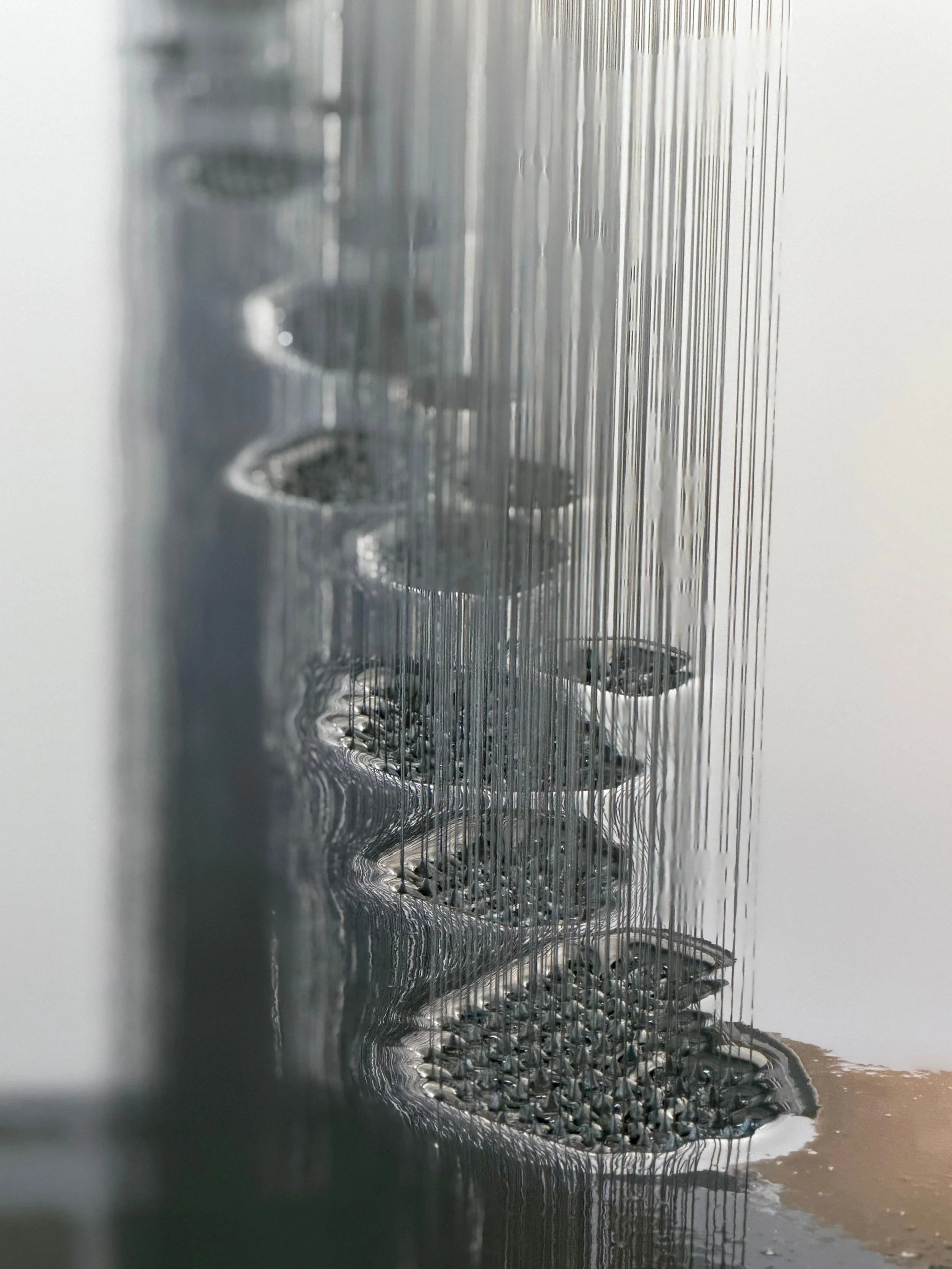
In photographs it looks like metal wires, or very thin strings stretched from ceiling to floor. Only in person does the shock arrive: they're not wires. They're liquid. Black oil falls from above at great speed, but in an unbroken stream — thin as a thread, perfectly vertical, on the verge of snapping and yet continuous. Below, there is no splashing, no foam, not even a ripple. A black surface receives it soundlessly, smooth as a lacquered mirror. I stood in front of this work and couldn't stop looking.
Kohei Nawa (b. 1975) is one of the most important Japanese sculptors of his generation — creator of the famous PixCell series and founder of the Kyoto-based studio Sandwich. He studied sculpture at Kyoto City University of Arts all the way to his doctorate. As he told Fram Kitagawa in an interview for Echigo-Tsumari, throughout his nine years of study he spent every summer at the Art Camp in Hakushu, working on outdoor sculptures alongside artists of the Mono-ha movement — and from the very beginning he was drawn less to sculpture itself than to the relationship between art and the human being.
Out of this grew the question that drives his entire practice:
"If sculpture was not to be a form of self-expression or a projection of my own 'self', the question became how to step away from my own body and let matter itself form the shape."
Force is the purest, most radical answer to that question. Nawa shapes nothing here — he simply shows liquid falling under its own weight. Gravity does the sculpting.
The material is a protagonist in its own right. It's silicone oil — a substance used as engine lubricant, with a viscosity close to honey (and, as the artist admits, more expensive than honey). It doesn't evaporate, doesn't change its properties in heat or at minus thirty degrees; it can be used for decades and remains the same. Above all, it behaves unlike any liquid we know. Water falling from this height would foam and splash. Silicone oil absorbs every wave and every bubble instantly — which is why the surface below remains a motionless black mirror. Nawa came across it around 2002, while searching for a liquid in which foam disappears completely (that search produced his earlier work FOAM). He waited over a decade to realise the idea. Under the ceiling, a pump works with output calculated to the litre: exactly as much liquid returns upwards as falls down. A closed circuit. Rain that never stops.
And here my part begins, because this work sometimes haunts my dreams — and I have to talk about it.
To me, Force is about compulsion. About what it means to be subjected to something — about a force we never chose pressing itself into our bodies and leaving its shape behind.Looking at those black lines, I saw everything that lasts too long for us to simply shake it off and begin again: slavery, war, violence, systemic oppression. Things that do not end with a single blow. They keep falling. And just as the wound begins to close, another drop hits exactly the same place.
The surface below will never know peace. It will always remain indented wherever the stream strikes it. But the longer I think about this work, the less straightforward that pressure becomes.It makes me think of systems, religion, school — everything that tries, from childhood onwards, to give us a particular shape. To teach us the same rules, fit us into the same frameworks, tell us what is proper, normal, desirable. To turn individuals into something coherent enough to function together as a society. And it is the repetition that unsettles me most.The stream keeps falling. After a while, you can stop noticing it. It also makes me think about the media. About the relentless stream of disasters, wars, violence, crises and endless “breaking news” designed to capture our attention one more time.
The problem is that human beings can become accustomed even to horror.
Something that once would have seemed unimaginable becomes, after the hundredth similar headline, just another piece of information we scroll past with our thumb. To make us react again, the stimulus has to become stronger. The story more tragic. The image more brutal. And slowly, it is not only the world around us that changes, but the boundary of what we are willing to accept.At the same time, I do not think that every form of pressure is inherently bad. Perhaps some of this “moulding” is simply the price of growing up.
Growing up means discovering that the world is not made of simple answers, and that good intentions do not always lead to good outcomes. That living alongside other people requires compromise. That we cannot always do exactly what we want. That there are social rules we sometimes need to accept — while somehow finding a way not to lose ourselves within them.
Nor do I idealise limitless individuality. Because if every individual pushes only in their own direction, another kind of force appears — centrifugal force. The community begins to fall apart. Instead of compromise, we end up with millions of people convinced that their own direction is the only correct one. Perhaps, then, pressure itself is not the problem. The problem begins when pressure leaves no room to move. When, instead of shaping us, it tries to break us. Maybe that is why Force hypnotises me so completely. The black and the white. The weight of the liquid. The way it drives itself into the perfectly flat surface of the mirror and pushes it down without making a sound. I want to step between the stream and the surface. To stand between the oppressor and the oppressed and, just for a moment, interrupt this closed circuit. But at the same time, I know that it is impossible to live a life without pressure. So for me, this moulding is also a form of knowledge — knowledge of the darker side of the world. An awareness of what human beings are capable of doing to one another, of how systems work, and of how easily we can become accustomed to things that only a short while ago would have seemed completely unacceptable. Perhaps the point is not to remain untouched. Perhaps the point is to remain yourself while being pressed into shape.
And as for me — like a good old pair of communist-era Polish knickers with industrial-strength elastic, I have absolutely no intention of snapping.
And you — is there a work of art that still won't leave you in peace?
