movements — 目 [mé]
Museum on Echigo-Tsumari (MonET) · Tokamachi, Niigata
https://www.echigo-tsumari.jp/en/art/artwork/movements/
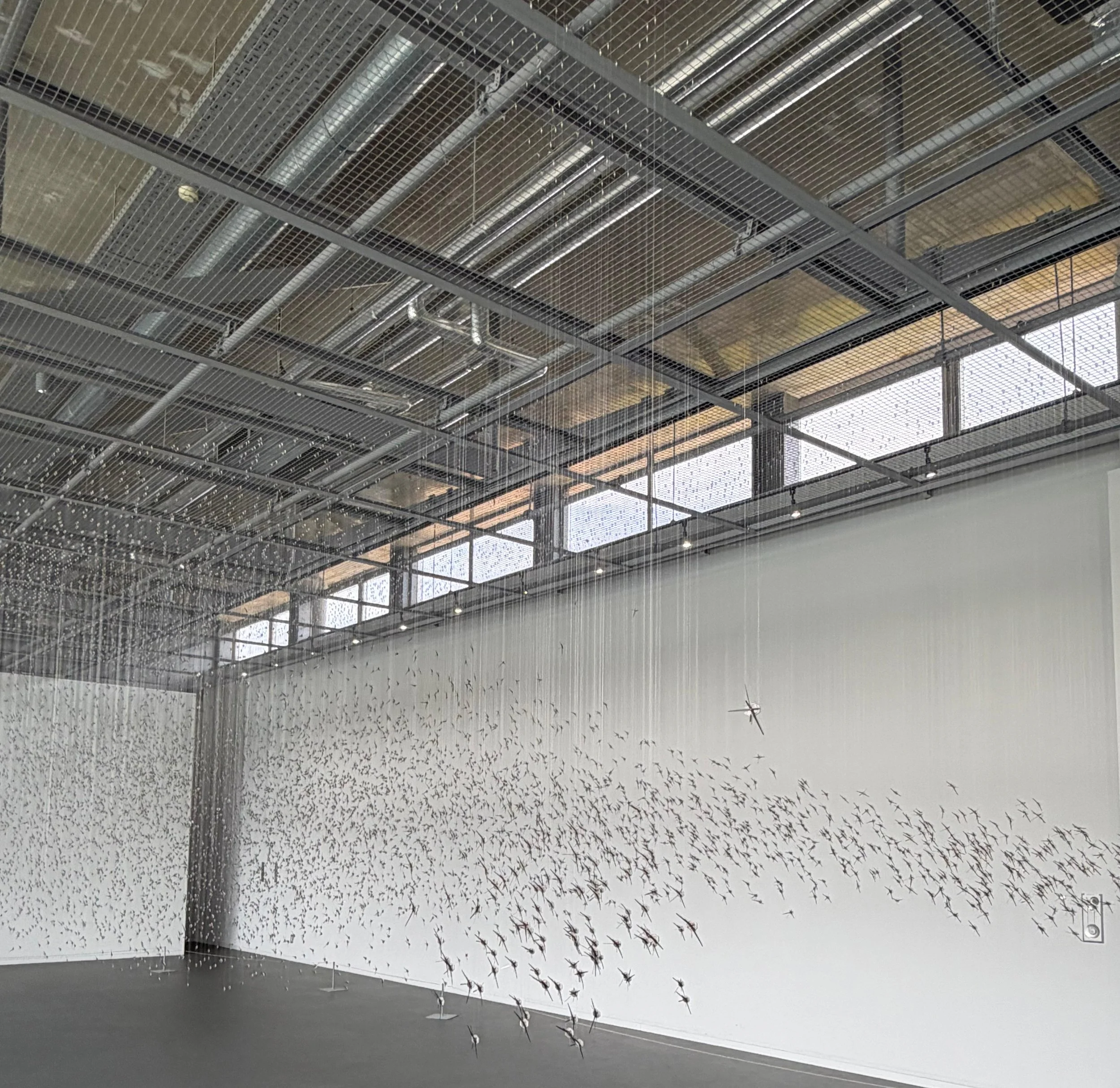
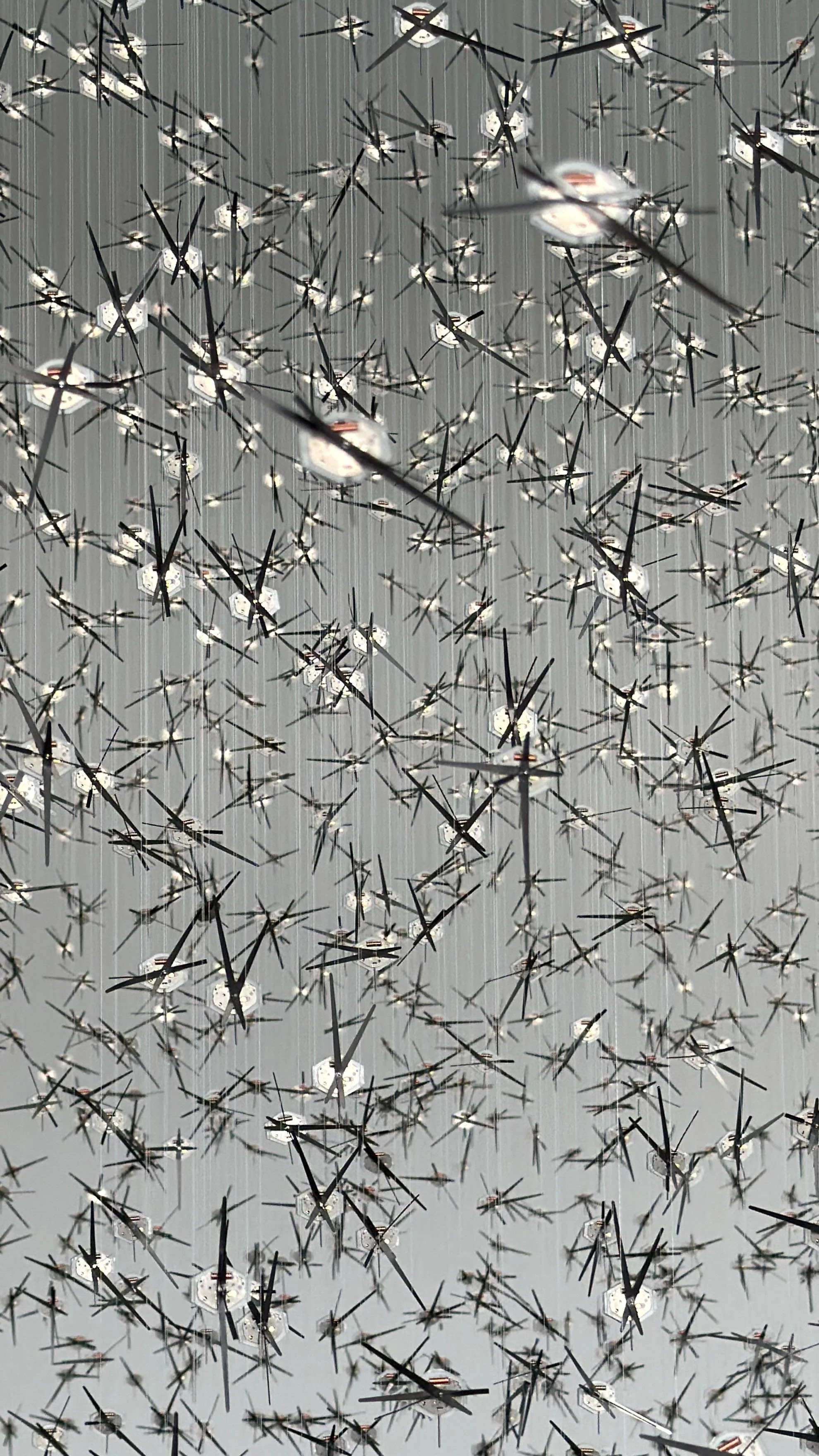
First, you see a flock. From the far end of the room it really does look like a murmuration frozen mid-flight — a dark cloud of small shapes spilled across the white wall, dense in the middle, thinning out at the edges. Only when I come closer does the sound reach me: ticking. Hundreds of unsynchronised ticks at once. And that's when I see they're not birds. They're clocks. The most ordinary small wall clocks — each running to its own rhythm.
Before I get to what happened inside me at that moment, a few words about the creators, because this isn't a single artist but a collective. 目 [mé] — simply "eye" in Japanese — is a team whose core is made up of artist Haruka Kojin, director Kenji Minamigawa and production manager Hirofumi Masui. The name itself is a declaration: their art doesn't begin in the object, but in the act of looking. movements was created in 2021, during the renovation of the MonET museum, and it welcomes (or sends off) visitors heading onwards from the museum — towards satoyama, the traditional rural landscape of Echigo-Tsumari.
It all began with starlings.
Before sunset, especially in autumn and winter, thousands — sometimes hundreds of thousands — of starlings gather in enormous groups. Instead of settling straight onto trees or reed beds, they perform an extraordinary dance in the sky: they form dense, undulating clouds that shift shape dynamically, resembling liquid or smoke. This phenomenon is called a murmuration. The most fascinating part is that the flock has no leader — each starling reacts, within a fraction of a second, only to the movement of its 6–7 nearest neighbours. A change of direction by a few birds at the edge of the flock ripples through the whole cloud like a wave. Perfect choreography with no conductor and no plan.
The artists of mé used to watch these flocks from their atelier in Saitama and — as they admit themselves — could sit and stare at them endlessly. Out of that fascination grew the thought that is the heart of this work:
"A starling itself is probably not aware that a 'flock' exists. It simply flies onward, driven by its own will. There is no bird controlling all the others. The starlings are inside a movement that nobody controls, and the flock only begins to exist when people look at it."
The flock exists only because someone is watching it. The bird knows nothing about it. It is we, the observers, who bring it to life.
In movements, the birds have been replaced with clocks — and this is where something wonderfully subversive happens. A single clock is the embodiment of meaning and rationality: it measures our time, orders our day, makes sense. But when there are hundreds of clocks and we look at them as a flock, that individuality disappears. What remains is the pure motion of hands — a response to the rotation of the Earth, in which we merely take part. Watch them long enough and the hands begin to seem connected: something ticks here, something ticks there, as if they were moving in sync. And yet nobody is steering them. That impression of interplay arises — once again — only because we are watching.
As a huge fan of the board game Wingspan, I was sold from the very first second — before I even understood the concept, I was simply delighted that someone had hung a flock of birds on the wall for me.
But it was the ticking that stayed with me. Each clock ticks slightly differently — like a pulse. Each of us has our own heartbeat, our own rhythm, our own pace. And yet we are always part of some collective: a family, a team, a crowd at a pedestrian crossing. And from the outside, what someone sees is not us — only a rippling flock.
Looking at Japan as an outsider, I experience this feeling completely differently than back home. People here seem somehow isolated from one another — each in their own world, their own silence — and yet they remain in harmony with each other and with their surroundings. Apart, but together. Like starlings. Like these clocks.
And I'd like us to pause over this for a moment. I have the impression that we look rather greedily towards the West and fixate on individualism — on being different, unique, visible. But no matter how much we'd like to stand out, we are, inevitably, part of a collective. Always. And it's worth remembering that — by treating others, and everything around us, with respect. The starling doesn't know it forms a flock. We can know. And it's worth looking at the world from that perspective.
