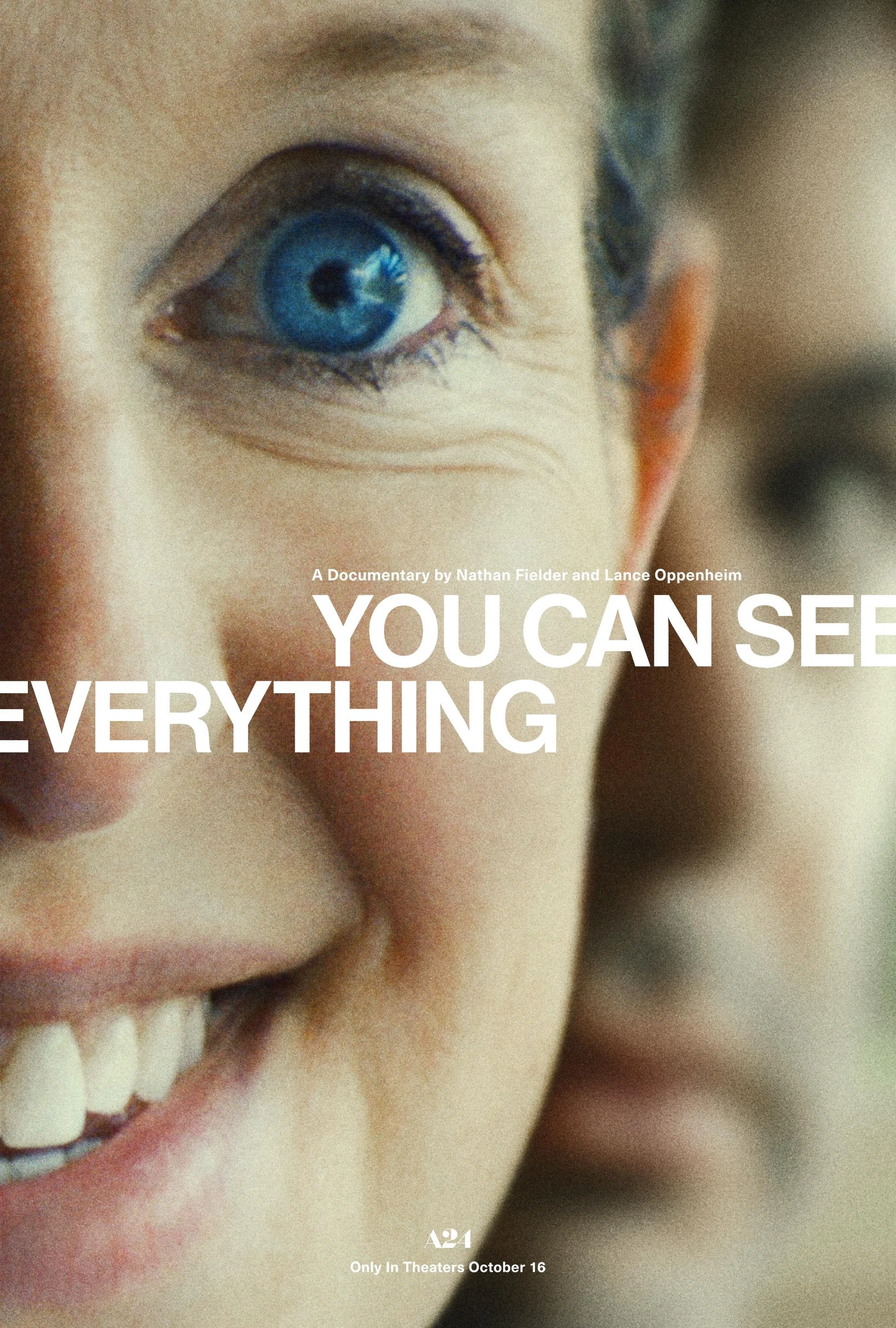
Why Would I Deceive You?
On Elizabeth Holmes, manipulation, truth, and the limits of our own objectivity
At the beginning of the film, the filmmakers ask viewers not to reveal the ending or the events leading up to it. However, since they've been openly discussing those very details in interviews, I've taken that as their quiet permission to share my own interpretation with you.
“Why would I deceive you?”
It sounds like an innocent enough question, the kind anyone might ask if they believed they had been falsely accused. The problem is that it comes from Elizabeth Holmes, a woman convicted of defrauding investors who spent years convincing the world that her startup was about to revolutionize modern medicine. And yet, when she looks Nathan Fielder straight in the eye and asks him that question, a little doubt begins to creep in. What if she genuinely believes she's innocent? What if she honestly doesn't think she deceived anyone? Or what if she knows exactly how she wants us to perceive her beliefs?
To me, Nathan Fielder and Lance Oppenheim's You Can See Everything isn't really a documentary about who Elizabeth Holmes is. It's about how difficult it becomes to remain objective when we're emotionally invested in trying to understand another person. And something even more unsettling: what happens when we can no longer tell whether we're looking at the facts or at our own interpretation of reality?
The Girl Who Was Going to Change Medicine
To understand this documentary, we first need to revisit the story of Theranos. In 2003, nineteen-year-old Elizabeth Holmes dropped out of Stanford University to build her own biotech startup. Her idea sounded almost too good to be true. Instead of conventional blood draws and multiple laboratory tests, all you'd need was a few drops of blood from a finger prick. A small device would supposedly be able to run dozens, and eventually hundreds, of diagnostic tests faster, more cheaply, and more conveniently than ever before. Earlier detection of disease, less pain, and better access to healthcare. What's not to love about that vision?
Holmes was also exceptionally skilled at crafting her public image. The signature black turtlenecks, the unusually deep voice, the unwavering confidence. The media began comparing her to Steve Jobs, and she increasingly resembled the heroine of a story about a young genius determined to change the world. Hundreds of millions of dollars poured into Theranos. Its investors included people with extraordinary business experience and political influence. By 2014, the company was valued at around $9 billion.
There was just one problem. The technology didn't work the way Theranos claimed it did. Its devices couldn't reliably perform the wide range of tests the company had promised. Many tests were actually carried out using conventional laboratory equipment made by other manufacturers rather than Theranos's supposedly revolutionary machines. Investors were given false or misleading information about the technology's capabilities, its applications, and the company's financial situation.
In 2015, Wall Street Journal reporter John Carreyrou began exposing serious problems at Theranos. Subsequent investigations, employee testimony, and regulatory proceedings eventually brought the company down. Theranos shut down in 2018, and Elizabeth Holmes faced criminal charges involving both investors and patients.
In January 2022, a jury found her guilty on four counts related to defrauding investors. She was acquitted on four counts involving patients, while the jury failed to reach a unanimous verdict on several remaining charges. In November 2022, she was sentenced to 11 years and three months in federal prison. On May 30, 2023, Holmes began serving her sentence at a federal prison facility in Texas.
And it's during the final weeks before that day that the central story of You Can See Everything unfolds.
The Final 34 Days
This was the first thing that struck me. Imagine knowing that in just a month, you're going to prison for years. You have two young children, a partner, and a family. You know that the life you've built is about to disappear, at least in the form you've always known it. No more ordinary mornings together, making breakfast, putting your children to bed, or simply spending time as a family. Those final weeks are something you'll never get back. And yet, you decide to invite a complete stranger and a film crew into your home. Not for a one-hour interview, but for 34 days. You allow cameras to document your family life, private conversations, intimate moments, and time with your children.
Why? Of course, everyone has a different understanding of privacy. Perhaps Holmes genuinely wanted an opportunity to tell her side of the story. Perhaps she wanted to leave her children a record of their lives together. But there's one thought I can't shake: Holmes spent years demonstrating that she understood the power of the media and public perception. Why should we assume she's suddenly forgotten how it works?
Meet Billy Evans
Another central figure in the film is Billy Evans, Elizabeth Holmes's longtime partner and the father of their two children. They met in 2017, when Theranos was already engulfed in scandal. Billy comes from a wealthy hotel-owning family in San Diego. His grandparents founded Evans Hotels, the company associated with properties including the Bahia Resort Hotel, Catamaran Resort Hotel, and the luxurious Lodge at Torrey Pines.
We don't know exactly how much money Billy personally has. Interestingly, following the documentary's release, Evans Hotels publicly emphasized that he isn't employed by the company, doesn't own a stake in it, and isn't involved in its operations. That doesn't mean his family has cut ties with him, though. Quite the opposite. His parents publicly supported Elizabeth Holmes during her trial. Billy's mother, Susan Evans, wrote a letter asking the court for leniency, while his father, William Evans, attended proceedings and initially introduced himself to reporters under a different name.
Our introduction to Billy in the documentary is rather unusual. First, we watch him working out, and shortly afterward, we see him completely naked in the shower. Why? Apparently, it was his idea. At least that's what director Lance Oppenheim said in an interview with GQ. According to Oppenheim, Billy suggested that the crew film him showering after returning from the gym. Billy later disputed that account. In an interview with CBS, he acknowledged knowing that he was being filmed but maintained that he had never agreed to footage showing his full nudity being used in the finished documentary. So, almost immediately, we're presented with two conflicting accounts of the same event.
And that's only the beginning. Billy is impossible to ignore. He has a forceful personality, takes charge, interrupts conversations, and seems determined to have a say in just about everything. In one scene, Elizabeth is making scrambled eggs. Billy decides she's doing it wrong and simply takes over. It's a small moment, but these little interactions gradually shape our perception of their relationship. He dominates; she gives way. He makes decisions; she appears to follow his lead. And that's when I started wondering whether I was watching yet another carefully constructed story.
When a Human Being Becomes a Digital Character
One of the documentary's most unsettling scenes involves the creation of a digital avatar of Elizabeth Holmes. Billy arranges a session during which her face and body are scanned to create a virtual version of her, one that can potentially be used to generate statements and videos resembling authentic recordings.
Initially, the explanation is almost touching. The avatar is intended to create videos for the children who will have to spend years without their mother at home. It could tell them stories, deliver messages, and preserve an image of their mother from before she went to prison. I can understand the emotional appeal. But then the possibility of using the technology far more broadly comes up. Billy considers making Elizabeth's digital likeness available to other users as well.
And this is where things get genuinely disturbing. Who gets to control what the digital Elizabeth says? Who decides which words are put into her mouth? And how are we supposed to know whether we're watching something a real person actually said or something generated by a computer?
Even more interestingly, Billy has power of attorney to represent Holmes in certain matters, and he acknowledges in the film that he manages much of her social media activity. So when we read a statement attributed to Elizabeth Holmes, how do we know she actually wrote it? Perhaps it's a message she sent from prison. Perhaps Billy edited it. Or perhaps, in the future, it could be generated by technology capable of replicating her voice and appearance. A documentary about truth introduces us to a world where distinguishing an authentic statement from its digital imitation may become increasingly difficult. It's hard to imagine a more fitting metaphor.
Theranos 2.0?
There's another reason Billy's behavior makes me uneasy. He's developing his own technology company, Haemanthus, which focuses on diagnostics and analyzing biological samples using optical technology. Sound familiar?
The phrase “Theranos 2.0” comes up in the documentary. Representatives of Haemanthus later strongly distanced themselves from that comparison, insisting that the company isn't a continuation of Theranos. According to publicly available corporate information, Elizabeth Holmes isn't listed as a formal founder. Still, the film shows how her image and her story begin resurfacing in connection with a new venture.
Is Billy exploiting Elizabeth Holmes? Is he trying to use her name, notoriety, and personal story to build his own business? Or do they both still genuinely believe in the vision that inspired Theranos in the first place? We don't know. But that uncertainty becomes one of the documentary's most compelling threads.
Amanda Seyfried: The Woman Who Has Already Been Elizabeth Holmes
This is where Amanda Seyfried enters the story. In 2022, she portrayed Holmes in the miniseries The Dropout. That matters because Amanda isn't approaching this world as a complete outsider. While preparing for the series, she spent countless hours studying Holmes's speech patterns, expressions, gestures, and distinctive low voice. She had already tried to understand the woman she was portraying.
Now Nathan Fielder shows her footage recorded inside Elizabeth and Billy's home. Initially, Seyfried wasn't supposed to appear in the documentary as an actress. She was invited to talk and watch the material. In a November 11, 2026 interview with Rolling Stone, she explained that her involvement developed in a rather unconventional way. She began participating in the project before fully coordinating everything with her agent and lawyer. Her attorney later had to make sure the necessary contractual protections were in place.
So this wasn't a carefully planned return to the role of Holmes. Amanda gradually became part of the project, and like Fielder, she found herself increasingly emotionally invested. But it wasn't Elizabeth who captured most of her attention. It was Billy.
Seyfried said she became almost obsessed with analyzing his behavior, even describing herself as something of a detective investigating Billy. When she watched the scrambled-eggs scene, she immediately stopped the footage. She couldn't believe what she was seeing. Over time, she became increasingly convinced that Billy was treating Elizabeth in a controlling way. She wanted to meet him in person, and eventually she did.
The Dinner That Changed Everything
Amanda's meeting with Billy is one of the film's most uncomfortable scenes. At first, she tries to have a normal conversation with him. She wants to give him a chance, get to know him, and perhaps better understand his behavior. But the atmosphere shifts, and the conversation becomes increasingly tense.
In her Rolling Stone interview, Seyfried said there was no reason for him to behave so aggressively. She also made it clear that she disliked the way he was using his partner.
For Amanda, Billy's behavior goes beyond simply having a dominant personality. She begins to see Elizabeth as a woman whose identity and personal story are being exploited by a man who claims to love her deeply. And this is where my interpretation of the documentary takes a very different turn, because I'm not convinced Elizabeth Holmes is the helpless victim in this story.
But What If Elizabeth Is Manipulating Billy?
I have no doubt that Billy behaves in ways that are difficult to watch. He can be patronizing, domineering, and downright unpleasant. I'm not interested in defending him. What I don't understand is why we're so quick to assume that because he behaves badly, Elizabeth must therefore be completely powerless. Those two things aren't mutually exclusive.
Elizabeth may experience controlling behavior from her partner while also being perfectly capable of influencing his decisions. She may genuinely love him while understanding that his behavior helps create a particular public image of her. She may be in a difficult relationship and still bear full responsibility for her own choices. Or perhaps she's simply very aware of how others perceive her.
That's my hypothesis. I suspect Elizabeth Holmes may be using the image of a woman dominated by her partner to encourage us to see her primarily as someone deserving of sympathy.
Think about her former image. A powerful businesswoman in a black turtleneck, speaking in that famously deep voice, radiating absolute confidence. A woman capable of persuading some of the most influential people in the world to believe in her ideas. And now? A blonde, blue-eyed mother of two. Calm, delicate, almost lost. A woman who appears to defer to a strong-willed partner.
Of course, I'm not suggesting that someone's hair or eye color says anything about their character. I'm talking about cultural associations, visual storytelling, and the enormous contrast between the woman we remember from the Theranos era and the woman we're shown now. Elizabeth Holmes understands the importance of public perception. She spent years building her image. Why should we assume she isn't doing it again?
I have no evidence that any of these situations were deliberately staged. But I find it hard to believe Holmes doesn't recognize how dramatically the conversation around her is changing. Suddenly, instead of focusing on why she deceived investors, we're discussing whether she might be a victim of her own partner. That's quite a remarkable shift in perspective.
Can You Believe in Your Own Innocence?
And this brings me back to the question that started it all. “Why would I deceive you?” What exactly is truth?
There are facts, events we can document, investigate, and verify. But there is also the way people perceive reality. One person believes in Jesus Christ, another follows the teachings of Buddha, and someone else might believe in a giant cosmic octopus. They don't necessarily need to convince anyone else that they're right. They may simply believe in their own worldview so deeply that, to them, there's no room for doubt.
That doesn't mean every belief becomes an objective fact. But someone can be absolutely convinced that their interpretation of reality is correct. And I think Elizabeth Holmes understands just how powerfully we respond to people who appear to genuinely believe what they're saying.
I'm not claiming that Holmes herself truly believes in her innocence. Quite the opposite. I suspect she may be deliberately presenting herself as someone whose belief in her own version of reality is so absolute that she genuinely cannot comprehend why she should be punished. It's a subtle but crucial distinction.
She doesn't have to convince us that Theranos's devices worked. She doesn't even have to convince us that all the accusations against her were unfounded. She only has to make us believe that she sincerely thought she was doing the right thing. And suddenly, our attention shifts from facts to beliefs. Instead of asking what she did, we start wondering what she really thought. Instead of examining the evidence, we try to understand her inner world, a place we have no actual access to.
We can't climb inside her head and determine with absolute certainty whether she believes every word she says. And that's precisely what makes this kind of image so potentially effective. After all, how do you prove that someone doesn't believe something they insist they believe?
One Sentence, Two Versions of Reality
There's a scene in the documentary that illustrates this problem beautifully. Fielder revisits earlier interviews with Elizabeth Holmes. An article in The New York Times, written by journalist Amy Chozick, contains a statement about the public persona Holmes created during the Theranos years. Holmes denies having said those words in the form attributed to her. She insists she was misquoted.
Nathan decides to investigate. He contacts the journalist and tries to determine what was actually said. Chozick stands by her account. She explains that she recorded the statement in her notes but doesn't have an audio recording that could definitively settle the dispute. Holmes, meanwhile, provides no recording that would support her denial either.
Suddenly, we're in a peculiar situation. On one side, an experienced journalist stands by her reporting. On the other, a woman convicted of fraud insists she would never have said such a thing. And Nathan is trying to establish the truth.
The longer he pursues it, the more interesting his reaction becomes, rather than the disputed sentence itself. Why is he so invested in resolving this one quotation? Is it because he wants to be journalistically rigorous? Because he's starting to believe Holmes? Or because he's no longer certain which of those motivations is driving him?
This, to me, is where the documentary becomes far more interesting than a straightforward story about fraud. We're watching someone who can no longer be entirely sure of his own objectivity.
Nathan Fielder: When the Observer Becomes Part of the Story
Fielder begins the project trying to understand Elizabeth Holmes. He asks questions, observes her daily life, and analyzes her statements. But the more time he spends with her, the harder it becomes to separate facts from emotional involvement. He starts seeing a woman who loves her children, lives in a complicated relationship, and appears genuinely affected by her circumstances.
And this is where the real danger begins. Not because empathy is a bad thing. Quite the opposite. The problem arises when we're no longer sure whether we're still presenting reality impartially. Are we showing what we actually witnessed, or are we unconsciously bending the facts to fit our own emotions? More importantly, can we still trust our judgment when we don't even know at what point we stopped being objective?
I think that's exactly what happens to Nathan Fielder. It's not necessarily that he starts believing Elizabeth Holmes. It's that he can no longer be sure whether his interpretation of events remains independent of the relationship he's developed with her. And that's when Amanda Seyfried steps in to help him reconstruct what happened.
Vertigo: A Woman Recreated From Memory
In the second part of the film, Fielder asks Amanda to portray Elizabeth Holmes again. But this time, it's nothing like her work on The Dropout. She isn't simply playing a historical figure based on a script and archival material. She's reconstructing conversations Fielder couldn't record, which means she's recreating Elizabeth through the director's memories.
Nathan corrects her gestures, expressions, and the way she responds to questions. He wants her to look exactly as he remembers Holmes. In his Rolling Stone interview, he explained that after one particularly important conversation in prison, he immediately recorded everything he could remember on his phone.
But memory isn't an objective record. We store events together with the emotions attached to them. We don't just remember what someone did; we remember how we felt when it happened. And that's why I find the comparison between You Can See Everything and Alfred Hitchcock's 1958 film Vertigo so compelling.
In Vertigo, Scottie, a former detective played by James Stewart, falls in love with a mysterious woman named Madeleine. When he loses her, he can't come to terms with her death. Later, he meets Judy, a woman who looks remarkably like his lost love, and gradually begins transforming her into the Madeleine he remembers. He changes her appearance, her hairstyle, her clothes. He wants to bring back the woman who exists in his memory.
The problem is that the Madeleine he knew was a character Judy had been playing all along as part of a deception orchestrated by another man. Scottie fell in love with an image someone else had created for him, and then tried to recreate that image himself.
I see a similar mechanism at work in You Can See Everything. Fielder is trying to reconstruct the real Elizabeth Holmes. But is he actually recreating her, or simply his own interpretation of the woman he met? And as Amanda tries to portray Holmes through his memories, isn't she also absorbing his emotional perspective?
That's why I see this documentary as much more than a story about fraud. It's also about the way we construct images of other people and how difficult it becomes to separate those images from reality.
The People Who Knew Elizabeth Holmes Before
There's something I think we should keep in mind while watching this documentary: the people who knew Holmes long before the film was made.
One of them is Tyler Shultz. Tyler worked at Theranos and was one of the whistleblowers who helped expose problems within the company. He also knew Holmes personally because his grandfather, George Shultz, a former U.S. secretary of state, served on Theranos's board.
After the documentary's release, Tyler published a critical essay in STAT questioning how Holmes was portrayed. He pointed out that the woman shown in the film was very different from the one he remembered. He also challenged the context in which a Theranos device was presented, arguing that the film showed a prototype in a way that could leave viewers with a misleading impression of the technology the company had actually used.
Interestingly, Tyler acknowledges that Elizabeth may genuinely be experiencing controlling behavior from Billy. But he doesn't believe that possibility automatically changes the assessment of her earlier actions. John Carreyrou, the journalist who exposed the Theranos scandal, raised similar concerns. He noted the contrast between Holmes's former public persona and the way she now presents herself.
This matters because we're not simply interpreting facial expressions or body language. We also have employee testimony, documents, and the findings of investigations. None of that disappears just because Elizabeth Holmes is capable of inspiring sympathy.
Family, Loyalty, and the Need to Believe
There's another story worth remembering. For a long time, George Shultz trusted Elizabeth Holmes more than his own grandson Tyler, who was warning him about serious problems at Theranos. To me, that's one of the most revealing examples of the power of trust. An experienced politician, a man who had spent decades in some of the most influential positions in American government, struggled to accept that someone he trusted might have been misleading him.
We see similarly strong loyalty among the families of Holmes and Billy, although that doesn't mean their motivations were necessarily the same. In their Rolling Stone interview, Fielder and Oppenheim explained that Elizabeth's parents had strong feelings about The Dropout. They believed the series had significantly influenced how the public viewed their daughter. That interest in the series was one reason the filmmakers decided to contact Amanda Seyfried.
Holmes's parents and Billy's parents therefore offer yet more perspectives that differ from the image presented by parts of the media. But this raises another question: does love and loyalty help us see someone more clearly, or can it sometimes make us unwilling to recognize things that might shatter the image we have of someone close to us?
And Who Is Manipulating Us?
This is a question I find particularly interesting. If the documentary is about manipulation, aren't the filmmakers also influencing the way we see its subjects?
They're the ones deciding which scenes we watch, how long a particular shot lasts, which part of a conversation receives emphasis, the order in which events are presented, and the emotions we're encouraged to experience along the way.
Oppenheim and Fielder spent more than a month with Holmes and Evans. They recorded hundreds of hours of footage, which eventually became a film running just under three hours. That doesn't mean the documentary is dishonest. But it does mean we're watching a particular interpretation of reality.
That's also why the dispute over money is so interesting. In the film, Billy negotiates a share of the documentary's future profits. Later, we're told he's given up that claim. But the story doesn't end there.
In November 2026, The Hollywood Reporter reported that Billy and his representatives had nevertheless negotiated a share of the profits, which was intended to go to a charity supporting children. The organization's name wasn't disclosed.
Was Billy trying to profit from Elizabeth's story? Did he believe that since the filmmakers were making money from their private lives, the family deserved a share? Or did he genuinely intend to use the money to help others? We don't know. And perhaps that's precisely why this episode fits so neatly into the rest of the documentary. Every new answer seems to produce another question.
Why I'm Writing About This Now
I'm writing this at a particularly difficult moment in my own life. Recently, my father was scammed and robbed by someone impersonating a bank representative. The scammer exploited the authority of an institution people trust with their money. He presented the situation so convincingly that my father believed him.
Whenever we hear stories like this, it's easy to ask, “How could anyone fall for that?” Surely all you have to do is hang up, verify the number, call the bank yourself, and refuse to share any information. Everything seems obvious once you already know how the story ends.
But similar scams happen to people in their thirties and forties, too. Educated, experienced people who handle complicated situations perfectly well in their everyday lives. Manipulation doesn't require a gullible person on the other end. It simply requires someone who knows how to exploit mechanisms we all share: trust in authority, the need to feel safe, confidence in our ability to assess a situation, and sometimes emotions that prevent us from thinking the way we normally would under calmer circumstances.
And I think that's why You Can See Everything affected me more deeply than I expected. Watching Nathan Fielder, I didn't just see a documentary filmmaker trying to understand Elizabeth Holmes. I saw someone beginning to question his own ability to judge reality, someone who knows he should maintain a certain distance but can no longer be sure he's doing so.
That's what I find most unsettling. Not simply the possibility that someone might deceive us, but the fact that we may not notice the moment we stop trusting our own judgment.
You Can See Everything. But Can You Really?
The documentary's title is almost ironic. You Can See Everything.
We see Elizabeth Holmes at home with her children and her partner. We witness some of the most private moments of her life. We see Billy trying to control his surroundings. We watch Amanda Seyfried become increasingly invested in Elizabeth's story. We watch Nathan Fielder begin questioning his own interpretation of events. And yet, we still don't know who Elizabeth Holmes really is. Perhaps we never will.
I don't know whether she's consciously manipulating Billy. I don't know whether she genuinely believes she's innocent. I don't know whether her current image is the result of a carefully considered strategy or simply a natural consequence of how her life has changed. But I suspect Holmes knows exactly how she wants to be remembered. Not as a woman who deliberately misled people, but as a visionary who believed in her idea so deeply that she couldn't accept its limitations.
And perhaps that's the most effective part of her public image. She doesn't need to convince us that everything she said was true. She only needs us to believe that she believed it herself. And then, instead of examining her actions, we begin examining her convictions. Instead of judging the facts, we try to climb inside her mind. And before long, we may become so invested in that attempt that we're no longer certain of our own conclusions.
I don't need Elizabeth Holmes to be a monster. I don't need Billy Evans to be the sole villain of this story. And I don't expect Nathan Fielder to give me a definitive answer about who Holmes really is. But I think we need to keep two very different things separate. Not knowing someone's true intentions doesn't mean we can't establish the facts of what they did.
We may never know what Elizabeth Holmes genuinely believes. But we do know what she was convicted of. And the fact that we can't know the whole truth about another human being doesn't mean every version of events is equally true.
Perhaps the most important question, then, isn't “Why would I deceive you?”
It's “How do I know I can still tell the difference between what I saw and what I've come to believe?”
