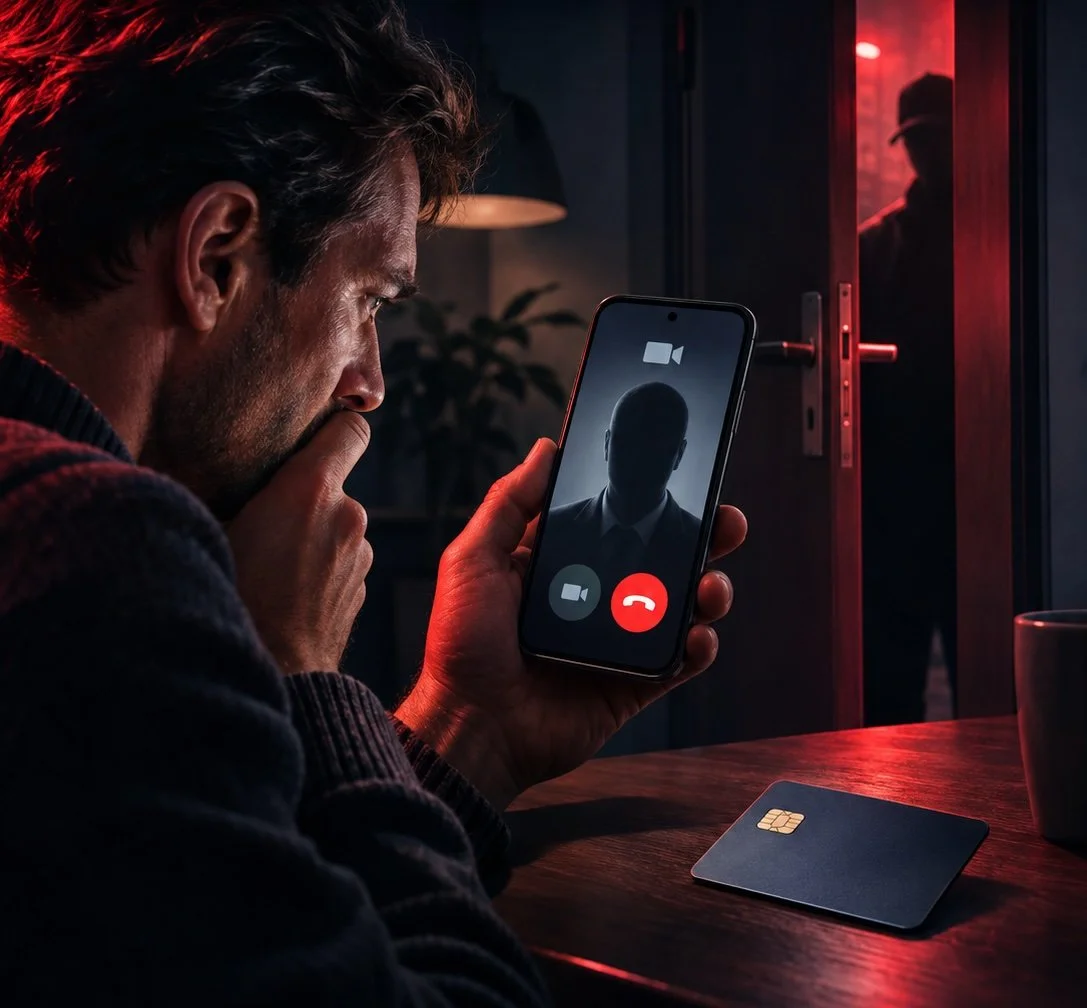
I'm writing this because someone scammed my dad. He got a call from a man who said he was from his bank, and he trusted him. Later I found out that several other people close to me had also been scammed – and not only older people. Some were my age, some were younger. I also talked to a police officer who told me about many similar cases.
These scams work because they are well prepared. The caller sounds professional, the number on your screen looks real, and you are put under so much pressure that you don't have time to stop and think. Here are the three tricks you are most likely to come across, and what to do about each of them.
1. "Someone has broken into your account"
How it works. You get a call from your bank's "security team". They tell you that someone tried to steal money from your account, but the bank stopped it just in time. To make sure it doesn't happen again, you just need to answer a few questions, confirm some details or approve something in your banking app.
What to do: hang up. Whenever someone calls you out of the blue, says they are from your bank and asks for information, codes or a decision about your money, end the call. Then call your bank yourself, using the number on your card, on the bank's website or in its app. If it really was your bank, you can sort it out with them then. Never call back a number the caller gives you.
Don't trust what you see. Scammers can make any number appear on your screen – even your bank's real hotline. Their text messages can show up in the same thread as genuine messages from your bank. They may even video call you on WhatsApp. None of this proves who they are.
Never, under any circumstances:
give anyone your login details, PIN or the codes your bank sends you,
approve something in your banking app that you didn't start yourself,
move your money to a "safe account" that the caller tells you about,
install an app the caller asks you to install, or let them see or control your screen,
hand your bank card to someone who comes to your door to collect it.
One more trick to know. You apply for a loan, the bank says no, and a few minutes after you leave you get a text saying it has been approved after all – you just need to confirm some details. Don't reply and don't click the link. Go back to the bank or call them yourself.
Good news: a new safety check is coming. Across the EU, banks must start checking that the name of the person you're sending money to matches their account number, and warn you if it doesn't. Countries that use the euro have had this since 9 October 2025, and banks in non-euro countries such as Poland must introduce it by 9 July 2027 at the latest. If your app ever warns you that the name doesn't match, stop – whatever the caller says. kir
2. "This is the police"
How it works. Sometimes, right after the "bank" calls, someone else rings and says they are a police officer. They confirm the first story and tell you that a secret investigation is under way. They may ask you to stay on the line, not to tell anyone – not even your family – or to hand over your money "to keep it safe".
What to do: remember that real police will never ask you for money. Not by transfer, not in cash, not for any investigation. Hang up and call the police yourself. If the call came on your landline, use your mobile to call, because scammers can sometimes keep the line open.
The officer I spoke to told me about an elderly woman who stayed on the phone with a scammer for a long time. When real police officers came to her door to warn her, she wouldn't let them in – because the man on the phone told her not to. That's what "don't hang up" is really for: as long as you're on the line with the scammer, you can't call anyone who could help.
If someone at your door says they are from the police, ask for their name and ID number and write them down. Then look up the number of your local police station yourself, call it, and ask whether they really sent someone to your address. If someone tries to force their way in, call 112 – the emergency number that works anywhere in the EU.
3. "We need your help to catch criminals"
How it works. The scammers pretend to be from a special investigation unit. In Warsaw, the police arrested people who did this in person: they came into homes, showed a fake document that looked official, handcuffed the person living there, emptied their safe and left. Other times it starts with a phone call: you're asked to help catch a gang by withdrawing your savings, making a transfer, or handing cash to an "officer" who will come to pick it up.
What to do: don't open the door, and don't hand anything over. No cash, no cards, no jewellery, no valuables – not until you have called the police yourself and they have confirmed the visit is real. An official-looking document is not proof. If someone tries to get in by force, call 112.
The same rule works for other scams too: a text about a parcel you need to pay extra for, a payment link from someone buying your things online, or an urgent message from "your boss" or "your son" asking for money. Before you click or pay, check in another way – open the app yourself, or call the person on the number you already have.
Can I get my money back?
It depends on how the money left your account.
If the scammer took the money themselves – for example, they logged in to your account with details they tricked out of you – EU rules say your bank should usually give the money back quickly, by the end of the next working day after you report it. There are exceptions, for example if the bank has good reason to believe you were involved in the fraud.
If you sent the money yourself because you were tricked, it's much harder today. Current EU payment rules have no equivalent obligation to refund victims of this kind of scam. addleshawgoddard
This is starting to change. The EU has agreed new rules that go further. If a scammer pretends to be from your bank and tricks you into approving a payment, the bank will have to refund the full amount, as long as you report the fraud to the police and tell your bank. The new rules aren't in force yet, and they only cover scammers pretending to be your bank – not those posing as the police or other authorities, or investment and romance scams. Until then, whether you get your money back depends on your country, your bank and what exactly happened. vixiosoprasteria
What to do if it has already happened
Call your bank straight away. Use the official number and tell them what happened. Ask them to block your card and your online banking, and ask whether any transfer can still be stopped. Note the time of your call and any reference number.
Report it to the police. Bring your phone and keep everything: text messages, call history, payment confirmations. Don't delete anything. Ask for proof that you made the report – your bank may need it.
Make a written complaint to your bank. Explain what happened, step by step, and list the payments you didn't agree to. Keep a copy of your complaint and the bank's answer.
Protect your identity. If your ID card or personal details may have been stolen, tell the police and the office that issued your ID. In Poland, you can also freeze your PESEL (national ID number) for free in the mObywatel app, on gov.pl or at your local council office. This stops anyone from taking out a loan or opening an account in your name until you lift the freeze.
Check if someone has taken out a loan in your name. In the EU, you have the right to see what a credit bureau knows about you. In Poland, that's BIK, which also offers alerts when someone asks for credit using your details.
Report scam messages. In Poland, you can forward suspicious text messages to CERT Polska on 8080. Other countries have similar services – your bank or police can tell you where.
Get free help if your bank says no. Every EU country has free services that help people in disputes with banks – in Poland, the Financial Ombudsman. If your bank is in another EU country, the European Consumer Centres Network can help you find the right place to turn.
How to protect your family – and yourself
Talk about it today. With your parents, but also with your brothers and sisters, your partner and your friends. Scammers don't only go after older people. Agree on one simple rule: if anyone calls and asks for money or personal details, hang up and call someone you trust first – even if the caller tells you to stay on the line.
Save your bank's real number in your phone, so you don't have to look for it when you're stressed.
Choose a family password that only you know, in case someone calls pretending to be a relative in trouble. Even then, hang up and call that person back on the number you have.
Check your limits. Look at how much money can be sent from your account or paid by card in one day. If it's more than you need, lower it. Ask your bank what else it can do to protect your savings.
If you live in Poland, freeze your PESEL now. It's free, and you can unfreeze it whenever you need to.
And if someone you love has already been scammed, start by helping. "How could you fall for that?" may be the first thing that comes to mind, but what they need right now is someone to help them call the bank and collect the paperwork. Scammers are professionals. Falling for them is not a sign of stupidity.
If this article helps even one person hang up on a suspicious call and phone their bank themselves, it was worth writing.
