The Midnight Library - Matt Haig
Every life is made up of millions of decisions.
Some are serious, others mean very little.
But each time we choose one way rather than another, the course of what comes next changes. An irreversible shift takes place, which in turn leads to further changes.
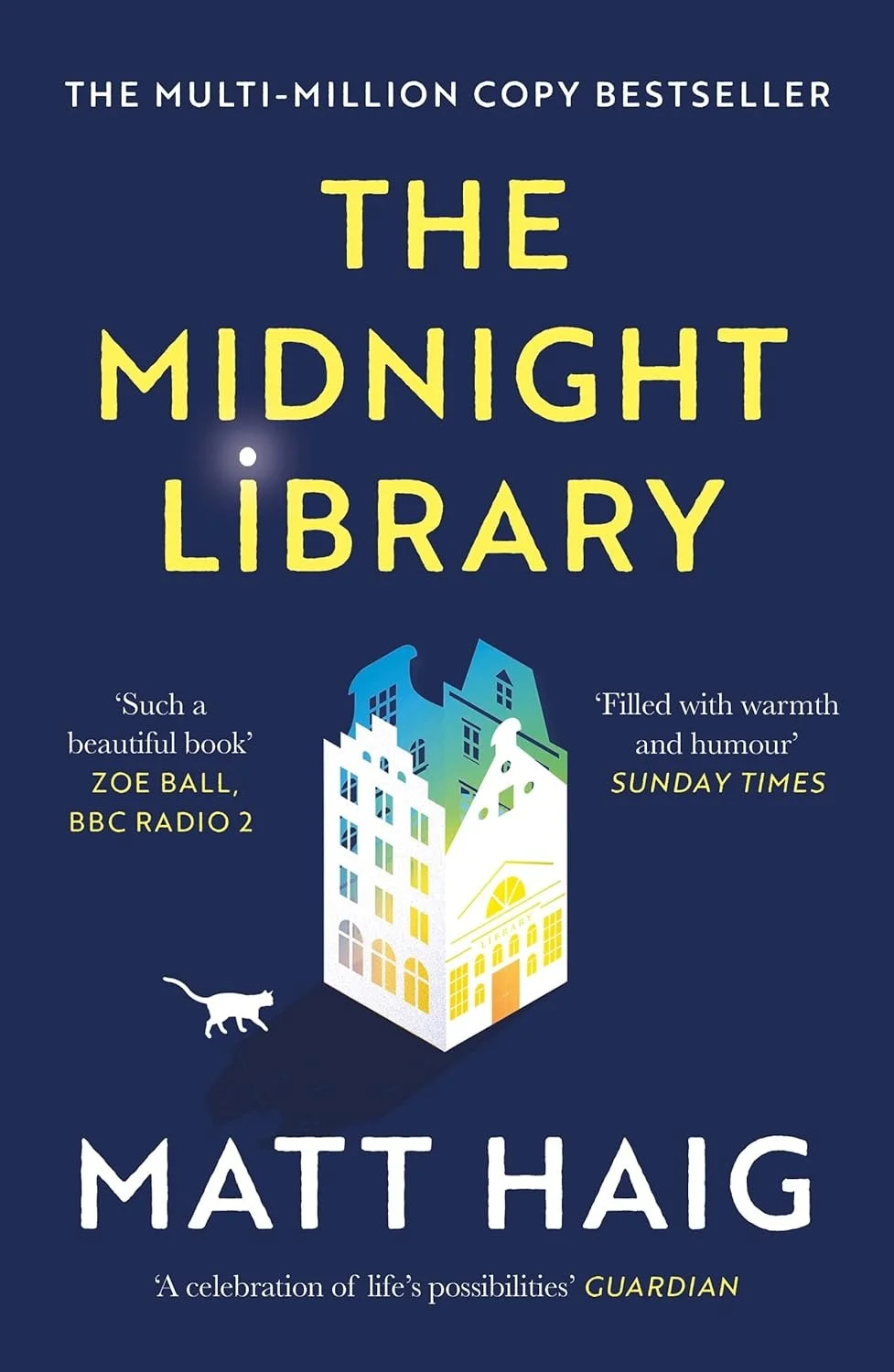
Somewhere beyond the edges of the universe, there exists a library filled with an infinite number of books. Each one tells the story of a different life — a life that might have happened, had we made different choices. We all ask ourselves from time to time: what if…
But what if we could truly find out?
Nora Seed is given that chance. When the death of her cat becomes the final drop that makes the cup overflow, she decides to leave this world — and finds herself in the Midnight Library. There, she can choose alternative versions of her life: live in another country, save her engagement, fulfill her dream of becoming a glaciologist. Each choice opens a new reality. Each book becomes another attempt to answer the question of what actually makes a life fulfilling.
The concept of the novel deeply moved me. The idea of living through multiple versions of one woman’s life is fascinating and offers enormous space for reflection. And yet… Nora as a protagonist frustrated me. In every reality she entered, something was wrong. Instead of taking responsibility for her choices, she kept escaping — from difficulty, from consequences, from life as it truly is.
“Every life is made up of millions of decisions. (…) These books are portals to every possible life you could have lived.”
Nora is unable to come to terms with loss in any form. Even when she becomes a rock star in one life, she is frustrated by the lack of privacy and the presence of a stalker — as if a life without failure, pain, or a price for success could exist at all.
“There is no life in which you can be permanently happy.”
It was precisely this naivety and sense of entitlement that irritated me at times. The constant “I want something else,” “I want more,” “something is missing” — without any real willingness to do the work on herself.
And yet… despite this frustration, the book leads to an important truth:
“We spend so much time wishing our lives were different, (…) when in reality almost every life contains both good and bad elements.”
Eventually, Nora has to understand that:
“Sometimes the only way to learn something, or to be sure of something, is simply… to live it.”
The Midnight Library reminds me of a truth I’ve lived by for years: our lives are in our own hands. If we want something, it’s not enough to dream about it or envy alternative versions of ourselves. We have to do the work — daily, often unrewarding, with no guarantee of success.
“People who persevere are no different from anyone else. The only difference is that they have a clear goal and are determined to achieve it.”
This is a book with a beautiful idea and an important message. Even though the protagonist often irritated me, I believe many readers will find a moment of breakthrough in this story — and perhaps look at their own lives with greater attentiveness, instead of searching for yet another “better version.”
It’s not about a perfect life. It’s about consciously living the one we have.
“It is astonishing to realize that the place we wanted to escape to was exactly the same place we were trying to escape from — that the prison was not the place itself, but our attitude toward it.”
📚 Who is this book for?
For readers who enjoy idea-driven fiction and what if? questions.For those standing at a crossroads, or struggling with regret over missed opportunities.For readers who need a gentle push to look more closely at their own decisions — without easy comfort or promises of happiness without cost. And for anyone willing to accept that no life is free from loss.
✨ Final thoughts
The Midnight Library does not offer ready-made formulas for happiness. Instead, it reminds us that meaning is not found in alternative versions of ourselves, but in attentively living the life we already have.It is a book that provokes thought — even when it frustrates. And perhaps it is precisely that frustration that forces us to ask the most important question of all:
do we truly want a different life… or do we simply not want to take responsibility for the one we’re living?
