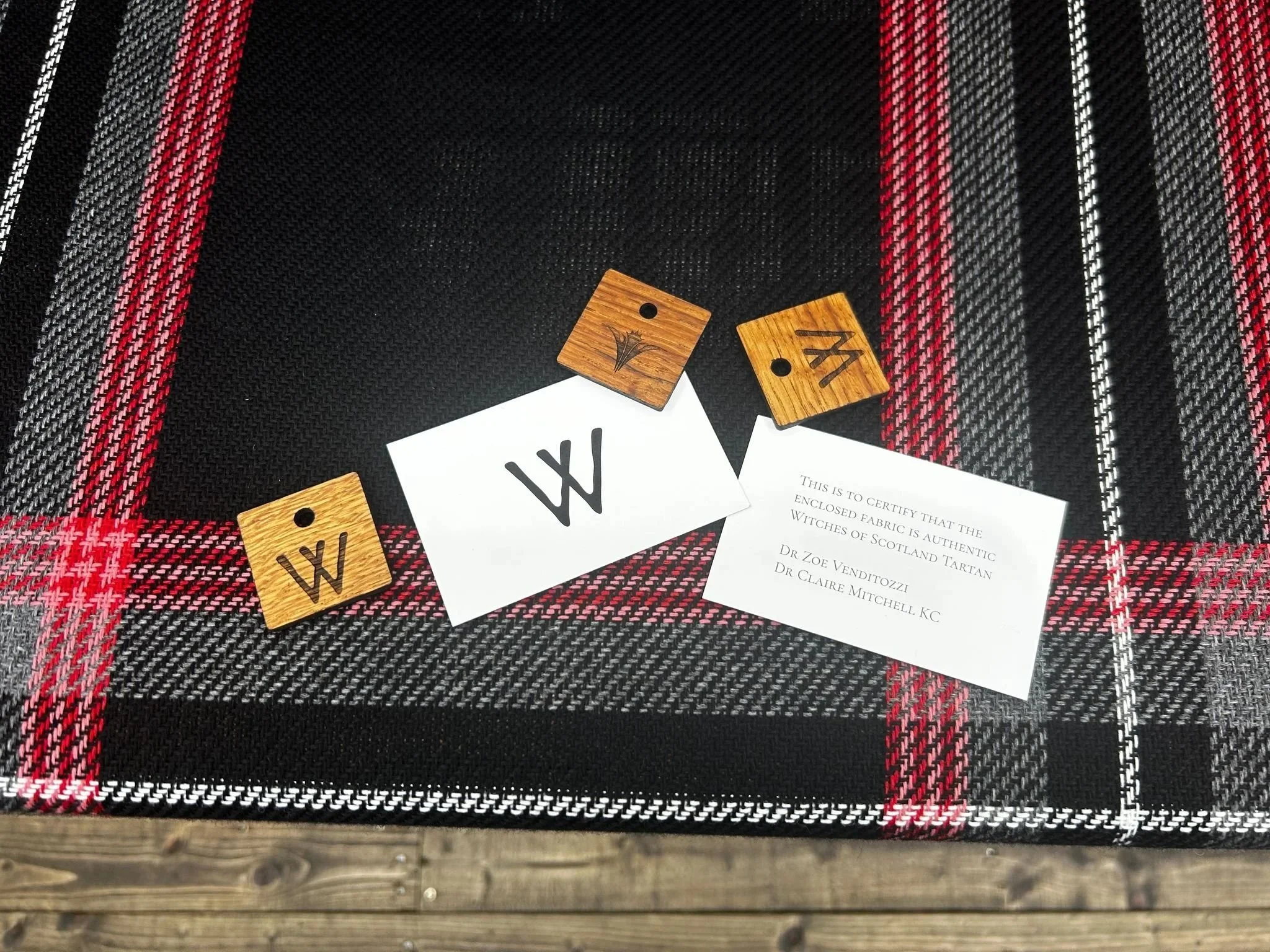
A Tartan That Tells a Story
I really enjoyed Witchcraft!. In the game, we lead a coven of witches trying to protect a village from supernatural threats. The villagers, however, see witchcraft as a source of evil and suspect us of being in league with the devil. We undertake missions, defeat monsters and try to convince a jury that we are defending the village. Using magic helps us fight, but it can also arouse suspicion and lead to our sisters being imprisoned. Intrigued, I began reading about witches, and one discovery led to another until I came across Witches of Scotland and the story of a Scottish tartan commemorating people accused of witchcraft.
Tartan is the distinctive Scottish checked pattern in which vertical and horizontal bands intersect to create a repeating arrangement of colours. Traditionally woven from wool, it was used to make kilts. Some patterns are associated with particular clans, but tartans are also created for families, organisations and places. This one was created in memory of those accused of witchcraft in Scotland.
Intriguing. And deeply moving.
Memory Woven into a Pattern
The Witches of Scotland tartan was initiated by Claire Mitchell KC and Zoe Venditozzi, the founders of the Witches of Scotland campaign. It was designed by Clare Campbell of Prickly Thistle, a weaving studio in the Scottish Highlands. On 11 February 2025, it was entered into the official Scottish Register of Tartans.
Claire Mitchell had the idea after visiting an exhibition about tartan at V&A Dundee. She recalled the inspiration:
“I saw people of different ages and backgrounds wearing tartan in all sorts of ways and talking about it. I thought it would be wonderful to create a pattern that told the story of the women executed for witchcraft—something we could wear to remember our own history. Tartan is not tied to one place. It is universal, so people around the world could tell this story.”
The tartan was intended to become a living memorial: something people could wear, show others and use to begin a conversation about the past. Unlike a stone monument, it does not remain in one place. It travels with people, carrying the story around the world.
The colours and thread counts were chosen deliberately. According to its creators, black and grey recall the dark period of persecution and the ashes of the victims. Red and pink refer to legal “red tape”: the system that entangled the lives of the accused and led to their convictions. A band of 173 black threads commemorates the years during which the Witchcraft Act remained in force. Narrower lines contain 15 and 17 threads respectively, representing the sums of the digits in the years the Act was passed and repealed. A white check formed from three threads symbolises the campaign’s three aims: a pardon, an apology and a national memorial.
Looking at the pattern, we can also find meanings of our own. To me, red evokes blood; pink, the fragile lives reduced to accusations; and black and grey, the emptiness left by those whose names and stories have disappeared. Perhaps that is where the pattern’s power lies: its creators gave the colours specific meanings while leaving room for our own emotions. It is more than a checked fabric. It is memory we can carry with us and share with others.
The People Behind the Numbers
The Scottish Witchcraft Act was passed in 1563. Both practising witchcraft and consulting someone believed to be a witch were crimes punishable by death. The Act ceased to apply in 1736. Persecution did not remain equally intense throughout that period: particularly severe waves of accusations occurred in specific years and regions.
The University of Edinburgh’s research database records more than 3,800 people accused of witchcraft in Scotland. Around 84 per cent of those whose sex could be established were women. The records are incomplete, and information about the verdict survives for only a small proportion of the accused. The frequently cited figure of approximately 2,500 executions is therefore an estimate rather than an exact count.
Those sentenced to death were usually strangled before their bodies were burned. Burning people alive, so familiar from popular depictions of witch trials, was rare.
The scale of the accusations becomes even more striking when we consider how small Scotland’s population was at the time. Speaking in the Scottish Parliament, Claire Mitchell said that the country had around 900,000 inhabitants in the seventeenth century. With more than 3,800 people accused, it was probably difficult in many communities not to know someone affected by the witch hunts: an accused person or someone close to them. Estimates also suggest that Scotland’s execution rate per head of population was around five times the European average.
For comparison, during the 173 years that Scotland’s Witchcraft Act was in force, more than 3,800 people were accused and an estimated 2,500 were executed. During the Salem trials of 1692–1693, more than 200 people were accused. Nineteen were hanged, Giles Corey died after being subjected to pressing, and at least five people died in prison. Scotland’s total number of accused was therefore roughly twenty times higher, and its estimated number of executions more than a hundred times higher. These figures cover very different periods, however: Salem’s relate to a single episode.
Reckoning with Salem took a long time and happened in stages. In 1697, Judge Samuel Sewall publicly apologised for his involvement in the trials. In 1711, legislation reversed the convictions of some of the accused. A 1957 resolution covered Ann Pudeator and “certain other persons”; the five other women concerned were not named individually until 2001. The last convicted woman, Elizabeth Johnson Jr., was officially exonerated in 2022—329 years after her conviction.
Two Women, Two Stories
Behind the numbers are individual lives. Among Scotland’s most notorious cases were the North Berwick trials of 1590–1591. When James VI was returning from Denmark with Anne, their ship encountered violent storms. The accused were alleged to have conjured a storm intended to threaten the king’s life. One of them was Agnes Sampson, a midwife and healer. James VI questioned her personally. Accounts describe her being tortured in Edinburgh’s Old Tolbooth, including with a spiked iron bridle. Her confession, most likely extracted through torture, included an account of witchcraft directed against the king’s ship. Agnes was convicted and executed in Edinburgh in 1591.
The second story is quieter, but perhaps even more poignant. In 1704, Lilias Adie of Torryburn in Fife was accused of witchcraft. She died in prison before she could be tried and a verdict reached. She was buried on the beach, between the high- and low-tide marks, beneath a heavy stone slab. It is the only known grave in Scotland of a person accused of witchcraft.
In the nineteenth century, her remains were dug up, and her skull entered a collection and was photographed. It later disappeared. Using the surviving photographs, researchers at the University of Dundee reconstructed Lilias’s face in 2017. Her peaceful expression seems particularly affecting when set against the accusations that led to her imprisonment
Remembrance Beyond the Pattern
The Witches of Scotland campaign seeks three things: a pardon for those convicted, an official apology and a national memorial. The apology came in 2022, when Scotland’s then First Minister, Nicola Sturgeon, apologised to those accused under the Witchcraft Act. A pardon has not yet been enacted. A proposed bill was withdrawn in 2023, and the campaign continues to identify a pardon and a memorial as its aims.
I love the idea that remembrance can be something we wear. The Witches of Scotland tartan refuses to let this history remain confined to a textbook or be pushed into a safely distant past. It reminds us that behind the accusations were real people, most of them women, and a system capable of turning fear and suspicion into convictions.
Perhaps that is why this story felt so closely connected to Witchcraft! for me. In the game, we lead a coven trying to save people who see us as a threat. Every use of magic carries a risk: it helps us fight, but also arouses suspicion, and when the jury remains unconvinced, our sisters are sent to prison. In a game, this is a mechanism we can try to navigate. In Scotland’s history, the accusations were neither fiction nor part of a board game’s storyline. They had consequences for real people, such as Agnes Sampson and Lilias Adie, for their families and for entire communities. The tartan cannot undo what happened, but it can encourage us to tell their stories again.
