„Hot Cakes”- Prateep Kochabua
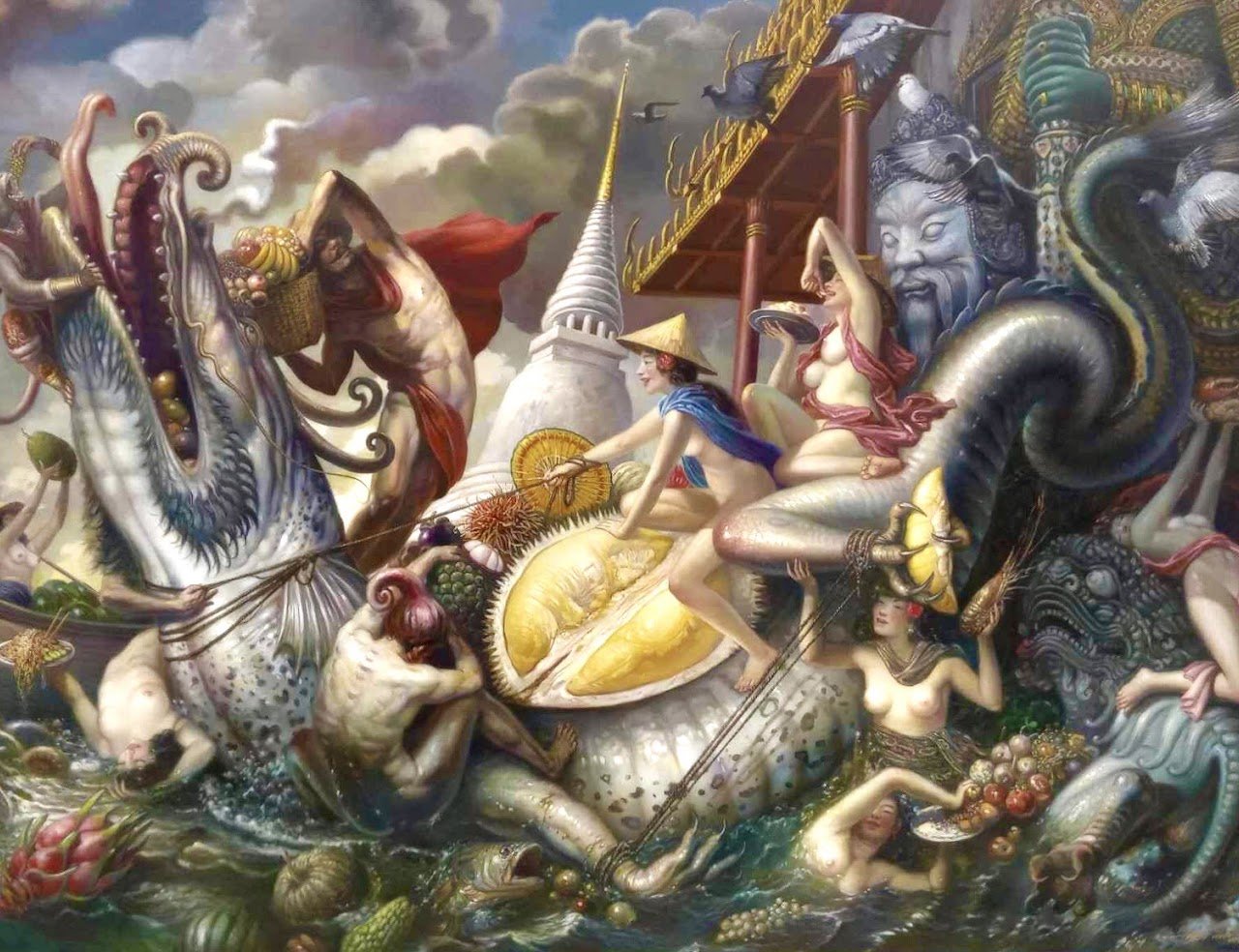
Oil on canvas, 145 × 200 cm, 2018
The author of the painting is Prateep Kochabua, one of the most significant contemporary Thai artists. He graduated in painting from Silpakorn University in Bangkok — an institution that played a crucial role in shaping modern Thai art. In his work, Kochabua often combines elements of everyday life with symbolism, mythology, and cultural motifs characteristic of Southeast Asia. His paintings, though saturated with color and seemingly fairy-tale-like, frequently carry a strong social critique, addressing the relationships between people and consumption, tourism, power, and economics.
Kochabua is known for large-scale canvases and a surreal visual language that allows him to approach difficult subjects in an indirect, metaphorical way. His works have been exhibited in numerous galleries and museums, and some are part of the permanent collection of the Museum of Contemporary Art in Bangkok. Hot Cakes fits perfectly within this current — beneath its vibrant, dynamic surface lies unease and a series of questions about excess, inequality, and the illusion of prosperity.
The artist describes the context of the work as follows:
“Tha Chang landing is an important tourist destination in the Rattanakosin Island area, where people from different countries come to explore and purchase various goods. Local vendors mainly sell fruit at high prices which, despite being expensive, are in high demand. This phenomenon reflects the Thai proverb ‘selling like hotcakes,’ benefiting the economy. From a Thai perspective, however, this can feel unreasonable, as many fruits are sold at prices much higher than usual. This difference may be influenced by currency exchange rates: foreigners perceive the prices as affordable, while many Thais feel dissatisfied buying products from their own country at inflated prices.
The painting depicts the area around Wat Phra Chetuphon Wimonmangkalaram Ratchaworamahawihan (Wat Pho), where I once encountered many Chinese tourists during my travels. Inspired by this experience, I incorporated dragons — symbols of China — into the work. Chinese tourists arrive and encounter numerous enticing shops encouraging them to buy various goods. It is as if a dragon has come to Thailand, offering and receiving goods. Through this work, I aim to draw attention to the situation of Thais who cannot afford to buy products in their own country.”
This work deeply moved me. It immediately brought to mind excess, opulence, and the mechanisms of consumption that have been troubling me for a long time. I find myself thinking more and more about the enormous amounts of food we waste — and about the true cost of its production. Not only the financial cost, but above all the ethical one: the cost of animal life, human labor, and depleted resources.
We are surrounded by supermarkets and stores overflowing with food. Products are manufactured on a massive scale, faster and faster, and often of increasingly poorer quality. We buy more than we can consume, and whatever remains unused is simply thrown away. Then even more is produced. The cycle seems endless.
Looking at Hot Cakes, I began to wonder whether we really need so much. Whether instead of accumulating and wasting, it wouldn’t be better to share what we have — to donate food to community fridges, shared pantries, or simply allow others to use what we ourselves won’t manage to consume.
I also couldn’t stop thinking about a personal experience — a birthday party where I ordered a large amount of sushi. More than half of it went to waste because there was no way to pass it on to anyone else. That memory stayed with me for a long time. Since then, I’ve tried to order less, plan more carefully, freeze food more often, or simply shop more modestly.
This painting triggered very personal questions for me — not about tourism or pricing, but about responsibility. About how easily we become accustomed to excess, and how rarely we stop to consider its consequences. Hot Cakes doesn’t offer simple answers, but it forces reflection. And that is precisely why it lingers in the mind long after you’ve stepped away from it.
