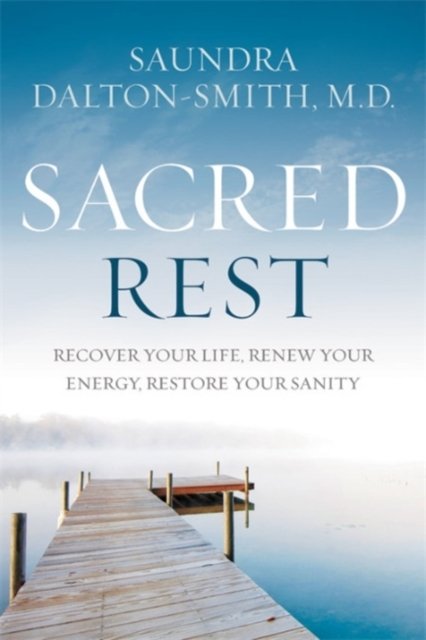
Sacred Rest — Dr. Saundra Dalton-Smith: Why Being Tired Isn't Always About Sleep
"Rest is not for weaklings. Hollowing out space for rest is work. Finding the time to rest is the arms and legs of the promises we want to keep. It means saying 'no.' It means setting boundaries for yourself. It means setting boundaries for others. It takes courage to rest in a results-oriented society. It takes strength to walk away from good in pursuit of best."
As you know, I've been feeling overwhelmed lately. Like "I can't carry anything more" and I was "running low on mana" — yes, those are Diablo quotes, because I felt like an RPG character with such terrible stats that she's barely alive and gets exhausted way too quickly. So I decided to read up on what the experts recommend.
And Dr. Dalton-Smith was a pleasant surprise.
In theory, the information in this book is obvious. But somehow it wasn't until Dr. Dalton-Smith laid it all out that I thought: "Wait — this is a shocking, obvious truth, and I've been ignoring it my entire life."
And I'm not alone in this. Her TED talk has millions of views, she's been featured in Psychology Today, Fast Company, CNN Health, and Prevention. Clearly, many of us needed to hear this.
What hit me the hardest
She went through exactly what I did — and I think so many of us just keep pushing forward without stopping to breathe.
"I'm a doer. If I'm not doing something, I'm wasting my time. At least that's what I thought — until a few years ago I found myself lying on the floor, looking up into the pleased face of my husband, who asked, 'What in the world are you doing on the floor?' Only one answer came to mind — I'm burning out."
I felt that in my bones. The curse of a doer — you go and go and go until your body literally puts you on the floor. And maybe it's time, "in my old age," to take care of myself, find some balance, and actually let myself rest?
"Rest is not for weaklings. Hollowing out space for rest is work. Finding the time to rest is the arms and legs of the promises we want to keep. It means saying 'no.' It means setting boundaries for yourself. It means setting boundaries for others. It takes courage to rest in a results-oriented society. It takes strength to walk away from good in pursuit of best."
Yes. Exactly. Rest takes more courage than hustle.
The key discovery — 7 types of rest
The most important idea that changed my perspective: "Understanding which type of rest you are deficient in is critical to correcting this imbalance."
Based on years of conversations with patients, Dr. Dalton-Smith discovered that "tired" is a word describing many completely different states — and we need to understand what exactly we need rest from.
She identifies 7 types:
Physical — You lack the energy for all the physical tasks on your list.
Mental — You feel like your thoughts can't keep up. Thinking about the upcoming day irritates or frustrates you.
Emotional — You beat yourself up over the smallest mistake. You feel down or angry when you think about your life.
Spiritual — You feel helpless, hopeless, trapped, or defeated.
Social — You feel alone in the world.
Sensory — You're hypersensitive to loud sounds and other stimuli.
Creative — You convince yourself that you don't deserve to take care of yourself.
Stop, look within, and listen
And I think this is key — that we stop and look within ourselves to figure out what we actually need. Hanging out with friends? Or maybe reading a book in silence and snuggling up with a dog? A walk in the forest? Are we overstimulated, physically tired, mentally drained — or maybe socially exhausted and just want to be alone?
And I really love that the author encourages us to test for ourselves what works:
"Consider how different activities affect your body. The chemicals released during activity have an effect on your muscles, nervous system, circulatory system, and respiratory system. Which activities give you energy? What habits create feelings of peace and relaxation? Try to find what restores you. Experiment with types of active physical rest to see which ones offer a deeper level of peace and well-being."
This isn't a one-size-fits-all prescription. It's an invitation to become a scientist of your own rest.
Dr. Dalton-Smith even created a free Rest Quiz to help you identify your personal rest deficit. It's worth taking before reading the book — then everything clicks faster.
You can also use the R-E-S-T method she proposes:
The R-E-S-T Method
The author also offers a concrete tool for working on yourself — the R-E-S-T method:
R — Recognize (Recognize your risk) — Identify which area of rest you're deficient in. Be honest with yourself.
E — Evaluate (Evaluate your current situation) — Take a look at where you are right now. What do you do every day? What drains you? What (if anything) restores you?
S — Science (Science and research) — Check what the research says. Don't rely on intuition — test and observe how your body and mind respond.
T — Today's application (Apply it today) — Not tomorrow, not next Monday. What can you do today to start resting in the way you actually need?
I love the simplicity of this approach. It doesn't require a revolution — just one small step today.
The hardest part — boundaries
The author also pushes us one step further — to set boundaries:
"Your boundaries will not please everyone. Boundaries are by definition confrontational. They are lines drawn on your life showing others how far they can go. They are lines in the sand revealing what you will and will not tolerate. And they are signposts to help you see when you are going off course and when others are no longer respecting your established limits."
And I think this is the most important — and the hardest — step on the road to real rest. So many of us struggle with this. We hand the oxygen mask to a friend instead of ourselves, even though it's completely illogical. We run on fumes of absurdity instead of taking care of ourselves first — because that's what society expects of us.
The "rest = spending money" trap
And I bet that depending on what you're missing, a lot of "standard" solutions won't actually help. A warm bath, a party, a trip — you might feel even more exhausted after them.
I relate to this so much! I was really stressed and tired, and even though I love traveling, I thought: "No. The last thing I want to do is go on vacation." And that's usually the first thing that comes to mind, right?
And here's my little tangent — because this is exactly what companies wanting to profit off us have programmed into our heads. Vacations, expensive luxury bath products, spa weekends… Somehow rest is always tied to spending money.
But what if it doesn't have to be? 😉 I encourage you to question that. Rest can be free. Silence. A walk. Doing nothing. Saying "no." Without buying anything.
The only downside
My only issue with this book — it’s a bit too much of a 'Christian Edition' for my taste. 😅. 😅 The chapters include Bible quotes, and the spiritual framework leans heavily on Christianity. But that's okay — the overall message transcends any single faith, and the practical advice makes sense regardless of your spiritual background.
My personal challenge
After reading Sacred Rest, I decided to:
Identify my rest deficit — Which of the 7 types am I missing? (For me right now: sensory and mental. Hence the silence.)
Experiment with what restores me — As the author suggests, test different activities and really pay attention to how I feel after them.
Practice setting boundaries — Even when it's uncomfortable. Even when people don't like it. The oxygen mask goes on me first.
Question the "rest = spending money" narrative — Rest can be free. A walk. Silence. Hugging my dog. Without buying anything. Besides books and board games ;)
If you feel tired but don't know from what — this book might give you the vocabulary you've been missing. Because maybe it's not about sleep. Maybe it's not about a vacation. Maybe you need a completely different kind of rest. 🌱
What about you? Which type of rest are you missing the most? Let me know in the comments!
