Look at What You Love — Shō Ishida, Welcome to the Kokoro Cat Clinic
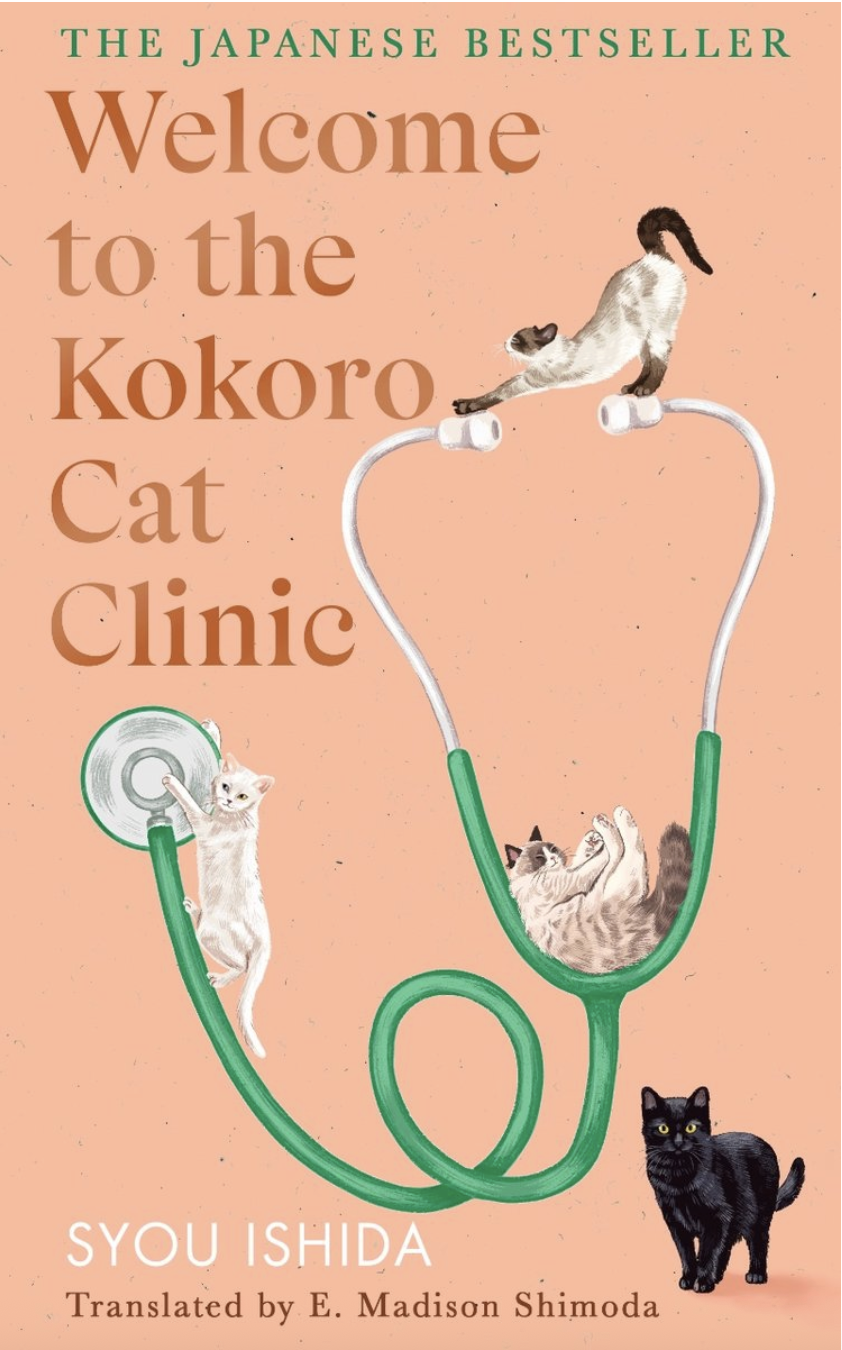
“Everyone struggles with different problems. They come in different colours and shapes, but most of them can be treated with a cat.”
After three Shō Ishida books, I should probably know the formula by heart. Someone gets lost in their own life, finds their way to the mysterious Kokoro Clinic, expects a diagnosis and a prescription, and gets a cat instead of medication. The setup barely changes, and yet somehow it still works on me every single time. These books are the literary equivalent of a cappuccino or a mug of hot chocolate when the world gets a little too loud. I don’t read them for plot twists. I read them because every now and then I need someone to remind me of things I already know but somehow manage to lose sight of between work, responsibilities, my phone and the next thing waiting to be ticked off.
Because when life keeps adding new items to the list, it’s incredibly easy to get caught up in the business of simply getting things done. What actually matters? How do you set priorities when everything feels urgent? Why are we working, shopping, cleaning the house, running errands and moving yet another task into the “done” column in the first place? Which parts of all this genuinely make us happy — and why are we always in such a rush?
“If you ever lose sight of your goal again, look towards the things you love. Just like cats do.”
I think it’s especially easy to forget that now, when we’re constantly trying to cram everything into one life: work, people, travel, self-improvement, hobbies, responsibilities, and a few extra experiences on top because surely it would be a shame to miss out. At some point, though, we stop really experiencing things and start consuming them instead. And moments are one-offs. You can’t put them aside and come back later to exactly the same version of them.
That’s why I like Ishida’s idea so much. Sometimes it’s worth stepping away from the endless optimisation project, prescribing yourself a dose of dog, doing something kind for someone, putting a little good karma back into the world, and simply being present with whatever matters to you right now.
“Fate can be fickle, but sometimes it knows what it’s doing. Meaning hides in things that seem insignificant, while what was supposed to matter turns out not to matter at all. Focus on what matters in this moment. Even if tomorrow it turns out to be something completely different.”
And I think this is what Ishida does best. She never really tries to convince us that a cat can cure a life.
“Cats can work miracles, but the effect of the treatment depends largely on the patient. If we don’t spend even a moment reflecting on difficult experiences, all they’ll leave us with is pain. You, however, thought about what happened and worked through your problem.”
If we never stop to think about what happened and understand anything from it, even the strangest experience won’t change much. The cat doesn’t do the work for the person. It simply disrupts the pattern. It interrupts the routine, forces them to look beyond their own head and makes them notice something they hadn’t been able to see before. The rest is still up to them.
My favourite storyline is about a patient who’s so overwhelmed by stress that instead of learning to relax, he goes to the clinic to… pretend to be a cat. He has a wife and a newborn baby waiting for him at home, but the pressure has built to the point where he doesn’t even want to go back. So at the clinic he learns to meow, hiss and let out emotions he normally can’t name, let alone express.
“Karaoke, laughter, running and going to the gym are generally considered good ways of dealing with stress. He, meanwhile, was imitating a cat’s meow with everything he had.”
It sounds ridiculous, which is precisely why it works. He isn’t supposed to become a cat. For a moment, he’s supposed to stop being an adult who has to understand everything, control everything and communicate everything sensibly. He just has to learn what it feels like to let the pressure out.
The best part comes later, when he starts hissing at home too. His wife initially looks at him as though he’s finally lost his mind, then bursts out laughing. From then on, whenever one of them reaches breaking point, instead of immediately spiralling into another argument, they howl or hiss like cats.
It doesn’t solve the exhaustion, the responsibility or the reality of having a newborn. What it changes is the way they carry that tension together. Something heavy that each of them had been holding separately turns into a shared language. The problem is still there, but for a moment it stops being something each of them has to drag around alone. Sometimes a little distance begins with something completely ridiculous.
There’s another detail in the same storyline that I loved: the patient also learns how to “scream silently”, because if the entire group started screaming at once, the neighbours might not fully appreciate the therapeutic method. This may be the most Japanese stress-management technique I’ve come across lately: release your emotions, but please don’t disturb anyone else. ;)
I also really liked the thread about relationships that can’t be rushed. One of the characters realises that she was so used to assuming people liked her that she automatically interpreted someone else’s distance as dislike. Her experience with a cat makes her consider a much simpler possibility: maybe that person has nothing against her at all. Maybe they just need more time. Maybe they’re cautious. Maybe they’re simply on different wavelengths. Or maybe they’ll never become friends — and that doesn’t have to be a tragedy either.
Cats are excellent teachers of this particular lesson, because it’s rather difficult to persuade a cat to like you on your timetable.
At one point, the characters even discuss whether cats are the tsundere of the animal kingdom — my favourite character type, naturally — prickly, aloof and sometimes downright hostile on the outside while hiding something very different underneath. One character objects, though, that cats don’t attack “for no reason”. The reason probably exists.
We simply may not know what it is.
I love that idea because it stretches far beyond cats. Not everything we don’t understand is directed at us. Someone’s distance doesn’t automatically mean rejection. Someone’s silence doesn’t necessarily mean dislike. And not everyone has to want to become our friend. We can try to close the distance, but we can also let it exist.
“Admitting to yourself that there’s something you simply can’t do takes a great deal of courage.”
We usually think of courage in almost exactly the opposite way. Try again. Push through. Grit your teeth. Prove to yourself that you can handle it after all. Sometimes, though, the most honest thing you can say is: no. I can’t do this. Not now. This is too much for me. And strangely enough, that can require more self-awareness than yet another heroic attempt to carry everything on your own shoulders.
The first book in the series was, for me, mostly a warm story about the way an animal can unexpectedly alter the course of someone’s life. In the second, much sharper claws appeared beneath the fur: I wrote about escapism, responsibility towards animals, “aesthetic adoption”, and how easy it is to turn a living creature into a plaster for our own problems.
This third book is quieter. Its message feels simpler: the cat isn’t the solution. It’s the thing that makes you stop for long enough to start looking for the solution yourself.
And perhaps that’s why I keep coming back to these books even though I know exactly what to expect from them. Not because I believe a cat can be prescribed like an antibiotic. I like that Ishida occasionally makes me stop and check whether I’ve accidentally confused living my life with working my way through a to-do list.
When everything gets too loud, I don’t always need another strategy for getting my life under control. A book can help. So can a good board game that switches the rest of the world off for two hours, or simply being with someone I care about. And sometimes all I need is a black nose and two black dots peeking out of a cloud of white fur in the middle of a white room.
And that really is enough. 🐾
What about you — what helps when the world gets just a little too loud?
