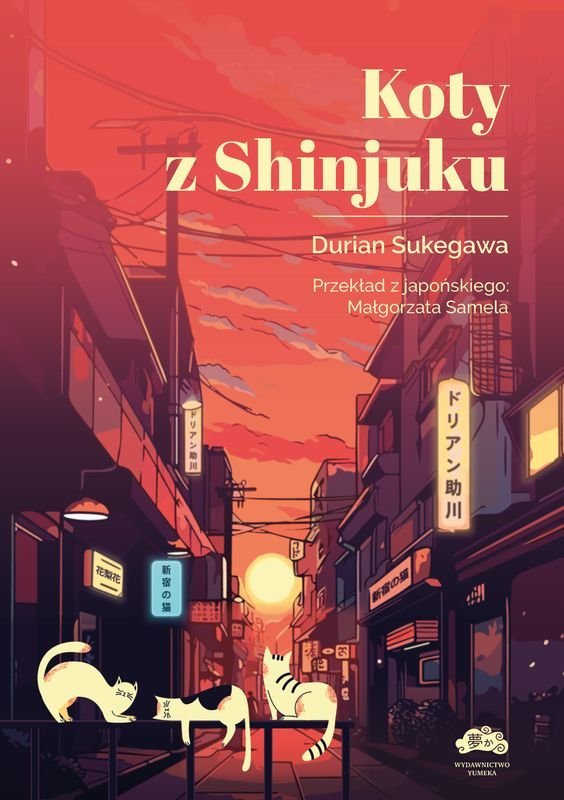
Light in the Alleyways of Shinjuku — "The Cats of Shinjuku", Durian Sukegawa
“I thought to myself that nothing lasts forever, everything is in constant flux. Even what we carry in our hearts fades like sand blown by the wind. The only thing that remains unchanged is the moonlight, illuminating every grain with its blue glow. That is why the truest miracle is finding, in our short lives, a person with whom we can form a deeper emotional bond.”
A book I especially recommend to fans of Artur Rojek’s songs: melancholically beautiful, yet filled with hope.
I devoured it in a single evening — I simply couldn’t stop reading. It was exactly the kind of story I’d been craving — one where the ending is positive but not “Disney.” It’s a tale of how a life shrouded in darkness gains radiance through a chance encounter with someone who carries their own shadows, and yet through that meeting, both find light. The story unfolds in Tokyo — in a world of late-night bars and stray cats, where people cross paths by accident and change each other’s lives.
“I thought to myself that nothing lasts forever, everything is in constant flux. Even what we carry in our hearts fades like sand blown by the wind. The only thing that remains unchanged is the moonlight, illuminating every grain with its blue glow. That is why the truest miracle is finding, in our short lives, a person with whom we can form a deeper emotional bond.”
I always hope to be the person who ignites a light in someone and helps them soar toward the sky, blazing like a star. I often meet such people on my own path too. In those moments I feel we are like atoms — colliding, rising higher, burning with a radiance we can share.
What’s remarkable about this story is that the person who transforms the protagonist’s life carries an incredibly heavy past herself. The fact that she can share her goodness is surprising, because that “glow” is anything but obvious — but I don’t want to give away too much of the plot.
Work as a “Dying Soul”
While I quietly lament that no one reads my “ramblings” (this blog 😉), the book’s protagonist, a television screenwriter, struggles with a similar problem. He creates programmes for faceless masses, not for a specific viewer he could know and understand. This makes his work Sisyphean — it brings no joy, leads to countless problems and complete exhaustion.
I think it’s worth mentioning something that caught my attention — and I believe it will catch yours too. The Japanese word for “being busy” — isogashii (忙しい) — conceals something extraordinary. It is one of the most poignant linguistic lessons this language has to offer — an almost poetic yet brutal warning encoded in writing. The character consists of two parts: on the left 忄, a simplified form of kokoro (心) — heart, soul, mind. On the right 亡 — to vanish, to lose, to die.
Literally: being busy is a state in which the heart dies. It suggests that when a person is excessively consumed by work, they lose touch with their own feelings, empathy, and what makes them human. It’s a state of autopilot, where you forget what matters and only hollow duty remains.
This is profoundly telling in a culture where people work to their last breath and taking a day off is often frowned upon. This attitude has its roots in the legacy of bushidō (the way of the warrior). Although the samurai are long gone, their value system — loyalty to the group, self-sacrifice, and gaman, the patient endurance of what seems unbearable — was “transplanted” into Japanese corporations after World War II.
In such a culture, work must be performed with total devotion. Even if it ends in death from overwork (過労死 karōshi), which remains a serious social issue in Japan to this day. In this context, karōshi is not perceived solely as a medical tragedy, but as a dark testament that someone “fought to the very end.” A tragic paradox — where the highest form of dedication leads to ultimate disappearance.
Darkness as Opportunity
Darkness emerges when we are frustrated by a lack of progress. Sukegawa hits the mark — where there is shadow, we can find a chance:
“When your efforts yield no results and no one pays attention to you, paradoxically that time becomes your opportunity for further growth. (...) Sometimes, when no one is paying attention to you, you just sleep and drink.”
I can say with my hand on my heart — it’s hard to keep inventing something new when everything rushes forward. Our prefrontal cortex, responsible for logical planning, switches to power-saving mode in comfortable conditions — why exert yourself when things are fine? But when real risk appears, the fight-or-flight instinct awakens something deeper. Only then do we truly mobilise and come up with things we’d never have seen in stable conditions. The paradox — to create something unconventional, life has to push us to the edge. And that’s exactly what the book’s protagonist manages to do. He chooses an unconventional path and finds a small success, peace, and joy.
Finding Your Own Path
“What sets us apart is the path we follow. Each of us has different eyes and sees the world differently. Although they tell us it’s our flaw — it’s our greatest asset.”
The ending of the book and the road the protagonist chose — a life that is modest but free from the compulsion of creating for the masses — is incredibly inspiring. It’s a lesson in living in harmony with yourself. Because after all:
“Sometimes the future escapes all imagination.”
And that’s what I wish for you ✨
