Seikatsu no Rizumu and Invisible Peaks — A Review of "Working Women’s Dilemmas" by Fumiko Yamamoto
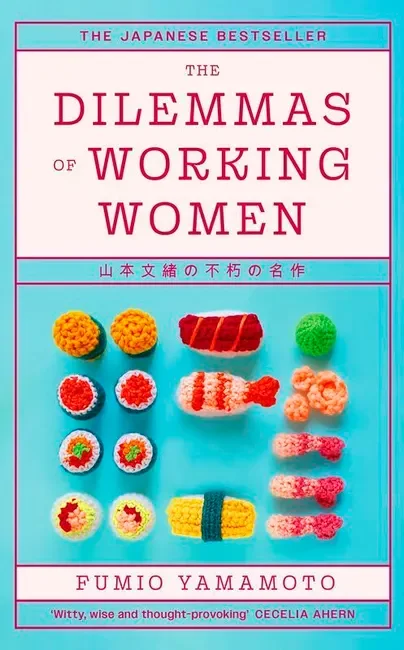
Seikatsu no Rizumu and Invisible Peaks — A Review of "Working Women’s Dilemmas" by Fumiko Yamamoto
Difficult and painful—perfect if you are in the mood for deep reflection. A feminist classic of Japanese literature, now available in Polish for the first time. The protagonists of Working Women’s Dilemmas are women who cannot and will not conform to the rules of a patriarchal structure. They are exhausted by imposed norms, rebellious, and searching for their own definition of freedom in contemporary Japan. With sharp humor, irony, and empathy, Yamamoto describes characters who refuse to meet others' expectations and question a world where a woman’s value is measured by productivity and life's meaning is subordinated to work.
This is how the publisher presents the book, but I don’t entirely agree that it is simply a drama about women in a patriarchal world. I do agree that it captures the silent pressure of coping with everything alone. These are diverse stories of women struggling with everyday life. Three of them moved me deeply. I will try not to give away too many details so that you can discover them yourselves.
The first thought is about how easily we judge or expect something from someone who perceives their past experiences differently. Despite a "victory," the protagonist still has to fight her internal battles, while society heartlessly expects her to return to "normalcy." This is incredible material for reflection, especially for me—someone who tries to be compassionate but is, at my core, a person of action. I am often surprised that people cannot or will not act, but this story teaches humility: it makes you realize that for someone else, even a small, seemingly mundane action can be like climbing Mt. Everest.
A similar story, though with a different tone, follows a "mother"—a caregiver for her own mother, her father-in-law, her husband, and her children. She takes a night job at a shop to provide for the family. What struck me most was that after she was nearly raped, she returned home and nothing changed. The day continued as usual—caregiving for everyone else. Physical and emotional care; worrying about whether they had food and how they felt, while she herself was treated as a robot without feelings of her own. Nothing changed until that afternoon, when her daughter returned home and "fired" her:
"I felt fired by my daughter—fired from being a mother. What did I do wrong? After all, I tried so hard to do everything the best I could."
As women, we step into the role of mother-caregiver because society demands and teaches it, and we often enter this role without thinking—by default. We lose ourselves in it, and everyone else loses us too; we forget who we are because social roles overwrite our true selves.
The third story, which is very close to my heart, is about a woman who regained her time but lost her sense of everything:
"When you don't have priorities in life, it is very difficult to make decisions."
And here, in the spirit of Japan that I love and admire, I believe that work provides the rhythm of life. Ikigai means a "reason for living" or a "reason to get up in the morning." It is the intersection of four elements: what you love, what you are good at, what the world needs, and what you can be paid for. Work that is an ikigai naturally organizes and fuels one's entire life. Talking to many guides in Japan—most of whom are elderly—I noticed they choose to work to maintain Seikatsu no Rizumu (生活のリズム).
Seikatsu no Rizumu (生活のリズム) literally means "the rhythm of daily life." Japanese people often use this phrase in the context of work (shigoto), which helps maintain a healthy routine, regular sleep hours, and activity. Work forces routine, but it also forces interaction with others. Of course, in Japan, due to the heritage of bushido (which I mentioned regarding The Cats of Shinjuku), this often goes to extremes. Nomikai is treated as an extension of work—building bonds, so-called nemawashi. Absence is often seen as a lack of commitment. The goal: strengthening relationships, breaking down hierarchies, and drinking alcohol together to loosen the atmosphere and facilitate the communication that is often lacking in a rigid Japanese office.
But for me, the story of this character trying to live happily while unemployed—despite feeling that something is missing—illustrates that a lack of work is not just a lack of money, but a lack of life's rhythm. Without this rhythm, without these priorities, we face a void where every decision becomes a burden beyond our strength.
I leave you with the question this book asked me most loudly: Does your daily rhythm of life help you be yourself, or is it just a cage that is slowly overwriting who you truly are?
