Ghosts in the Surface of Air — Tsuruko Yamazaki
The Work
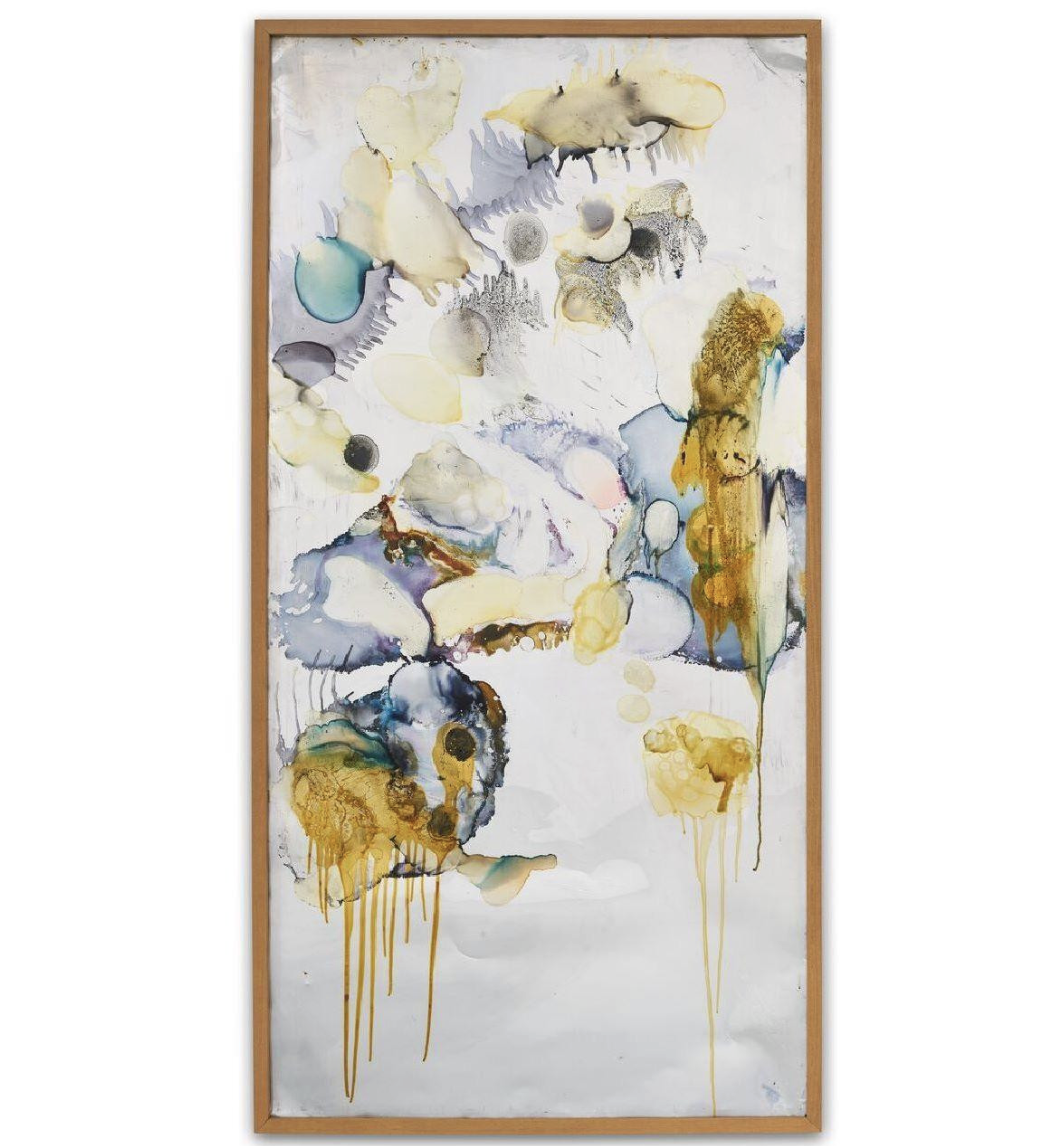
"Work", 1957 Aniline dye and lacquer on aluminum MoMA, Floor 4, Gallery 405, The David Geffen Galleries
The Artist
Tsuruko Yamazaki was born in 1925 in Ashiya, Japan. She was the only woman who remained in the Gutai group from its founding until its dissolution. Known for breaking conventions, she worked with reflective materials, metals, tin cans, and aluminum panels that she stained with aniline dye. Over time, the oxidation of these compounds produced spectacular shades of magenta and earthy tones. She also experimented with light installations, painting on mirrors, and later transitioned to canvas, creating bold geometric patterns and vivid abstractions.
"Although her work's range and vibrancy of colors are what most immediately catch the viewer's attention, to describe Yamazaki as a colorist would be to diminish the urgency with which she has sought to denature the bond between materials and their expected uses." — Joan Kee, Artforum
Despite her enormous contribution, international recognition came late — her first European solo exhibition didn't happen until 2010, in Paris, at Galerie Almine Rech.
My Thoughts
This is one of those paintings that captivated me instantly. And when I read the artist's name — my heart felt even warmer. Japan. The country of my soul.
What makes this painting so mesmerizing? Unfortunately, you can't see it in a photograph — but the painting is made on aluminum. When the viewer moves, the image shimmers like a lake in the glow of the sun. You can see golden rays of sunlight traveling across the aluminum surface — but they're really just reflections of the museum lights. Yellow becomes gold, colors take on a radiance and warmth.
And there's something deeply spiritual in it. Something of Shinto — spirits that come alive in the surface of air. As if every splash of dye were a separate kami — a spirit inhabiting matter, bringing it to life depending on how you look at it.
Kami — Japanese deities, spirits, forces of nature, or beings possessing supernatural power (tama). They are not omnipotent gods in the Western sense, but beings worthy of reverence — inhabiting elements of the landscape (mountains, rivers), atmospheric phenomena, and the spirits of ancestors. Kami can be gentle and nurturing (nigi-mitama) or destructive and fearsome (ara-mitama). But they are usually very mischievous — which is why, in this painting, we see streaks of kami darting about like atoms.
I think that's what our thoughts look like too — free atoms colliding with each other, forming positive or negative images. They merge into yōkai and scatter into small, friendly spirits. And once again it's worth pausing to ask — are our thoughts like an empty lake surface that absorbs and reflects whatever surrounds us? Let's remember to make time for nature and for the people who ignite a glow within us.
Yamazaki didn't paint pictures. She created living surfaces that change alongside you. And maybe that's exactly the point — that beauty is not fixed. It shimmers, shifts, depends on your perspective. All you have to do is move. 🌊
