Before we dive into the work itself, it’s worth introducing the creators, as this duo is a true legend in the world of contemporary art.
Ilya and Emilia Kabakov are artists originally from the USSR (born in Dnipro, in today’s Ukraine).
Ilya Kabakov (1933–2023) was a key figure of Moscow Conceptualism. For years, he led a double life: officially, he was a respected children's book illustrator, but in the underground, he created installations that exposed the absurdity and stagnation of Soviet reality.
Emilia Kabakov (born 1945), a pianist and curator, became Ilya’s inseparable creative partner starting in 1989.
They are famous for the concept of the "total installation," where the viewer doesn't just look at a painting but physically enters the artist's world—into someone's apartment, a government office, or in this case, "The Palace of Projects." This monumental work from 1998 gathered 65 projects allegedly created by "ordinary people" who wanted to fix the world or themselves through strange instructions. The wing project presented below is Project No. 12.
Project No. 12: Instruction
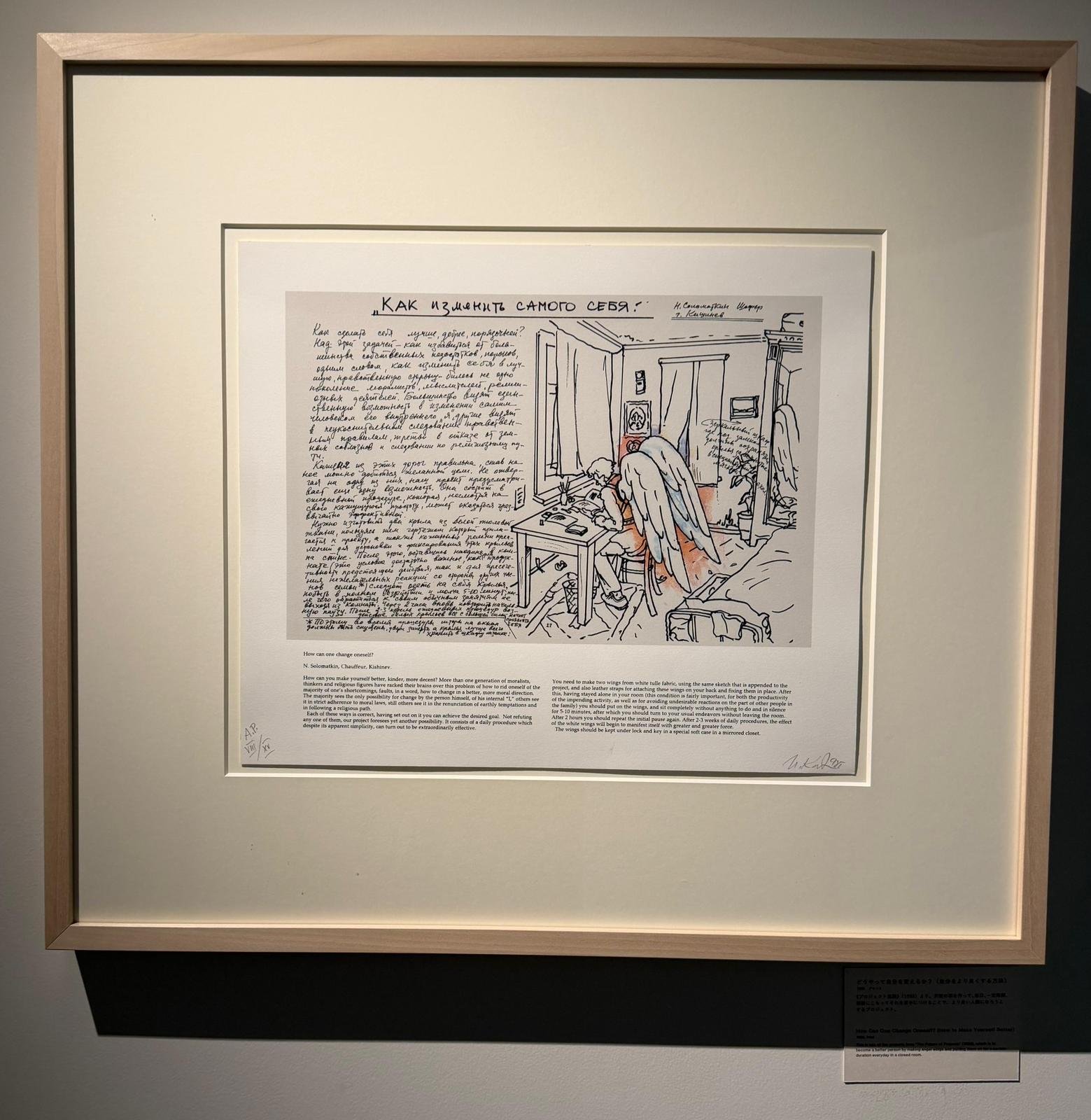
"How can you make yourself better, kinder, more decent? More than one generation of moralist, thinkers and religious figures have racked their brains over this problem of how to rid oneself of the majority of your shortcomings, faults, in a work, how to change in a better, more moral direction. The majority sees the only possibility for change by the person himself, of his internal "I," others see it in strict adherence to moral laws, still others see it in the renunciation of earthly temptations and in following a religious path.
Each of these ways is correct, having set out on it you can achieve the desired goal. Not refuting any one of them our project foresees yet another possibility. It consists in the daily procedure which despite its seeming simplicity, can turn out to be extraordinarily effective.
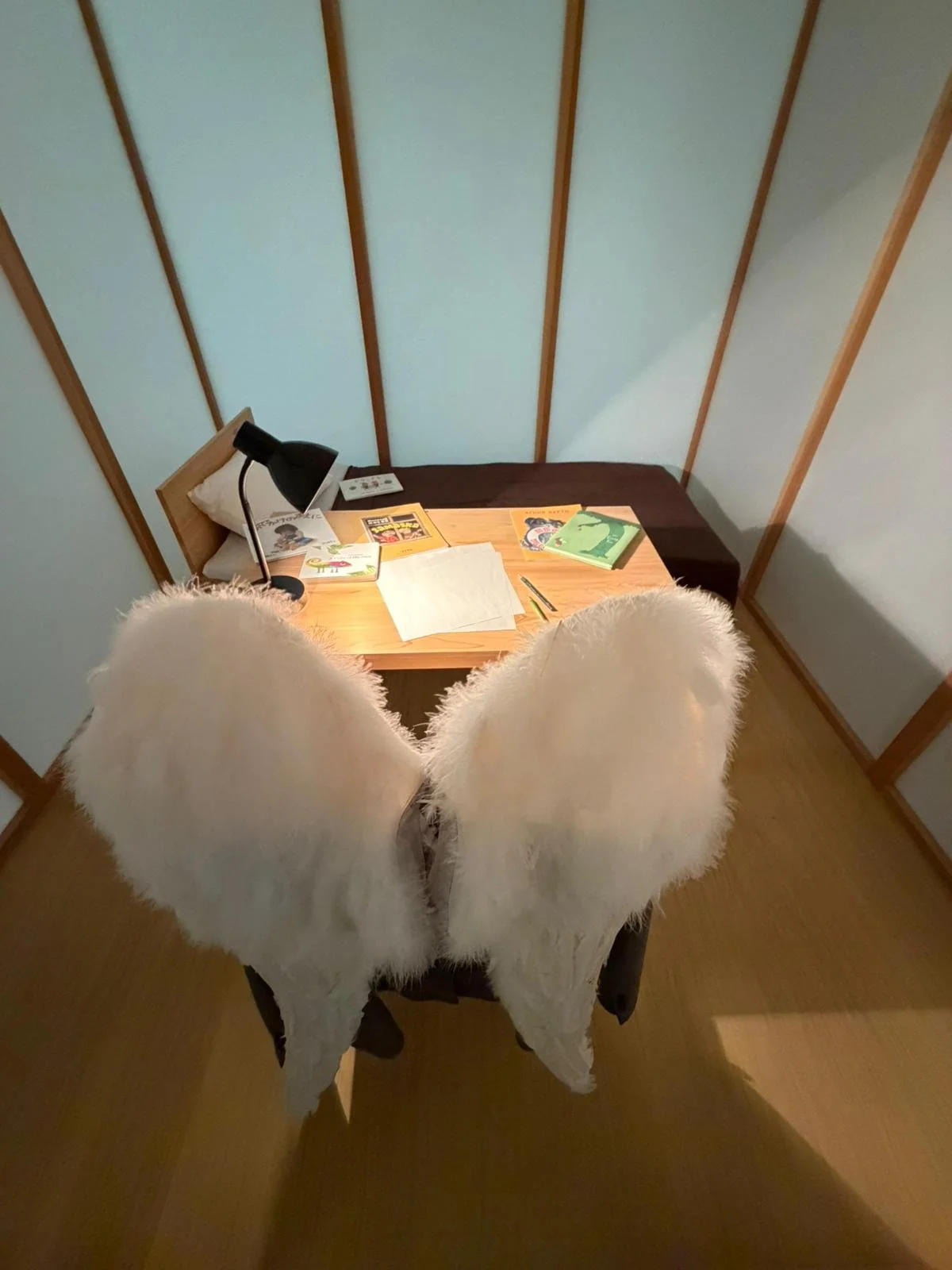
You need to make two wings from white tulle fabric, using the same sketch that is appended to the project, and also leather straps for attaching these wings on your back and fixing them in place. After this, having stayed alone in your room (this condition is fairly important, for both the productivity of the impending activity, as well as for the avoiding undesirable reactions on the part of other people in the family) you should put on the wings, and sit completely without anything to do and in silence for 5-10 minutes, after which you should turn to your usual endeavours without leaving the room. After 2 hours you should repeat the initial pause again. After 2-3 weeks of daily procedures, the affect of the white wings will begin to manifest itself with greater are greater force.
The wings should be kept under lock and key in a special soft case in a mirrored closet.
Instructions:
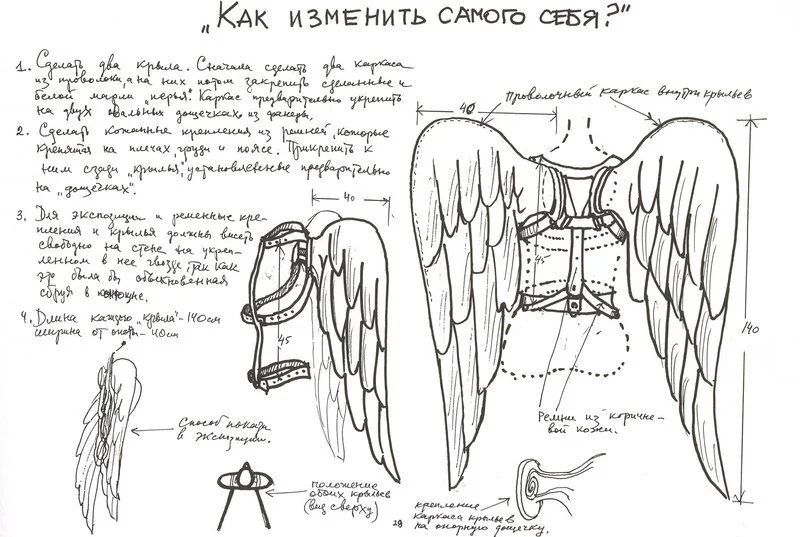
Make two wings. First make two frames of wire and attach to them the wings made of white gauze. The frames should first be attached to two oval boards of plywood.
Make leather straps from belts which can attach to the shoulders, chest and waist. Attach the wings which have already been attached to the boards to the straps.
For the exposition, both the wings and the straps should hang freely on the wall on a nail, as though it were an ordinary harness in a horse stable.
The length of each wing is 140 cm, the width from the center support is 40 cm."
Sounds familiar?
This description both moved me and made me laugh to tears. Of course, this is my subjective opinion, but I find it to be a brilliant parody of faith and empty ritualism. We go to church, we pray, and then we just go about our business anyway. We pray, we put on our wings for two hours a day, and we believe that this scrupulous adherence to a ritual will suddenly turn us into a good person.
I treat this as a flick on the nose and a joke. They say "deeds define a person," but not all deeds are created equal. Putting on wings is not the same as lending a helping hand or simply being understanding.
Being a good person—what does that even mean? It’s another intriguing concept, and everyone asked would surely give a different answer. What’s more, some can even use various methods of oppression against others—paradoxically "for their own good"—just so they can feel like... a good person.
But what amuses me most is the fact that these wings must be kept under lock and key so that no one steals them. It’s a kind of "private holiness"—I want to be better, but only for myself; God forbid anyone else uses my shortcut to heaven.
And then there’s the mirrored closet. This is, without a doubt, the most ironic detail of the whole instruction. Why do we need mirrors? So that we can analyze our "transformation" in real-time. We check ourselves before putting the wings on and again after two hours of practice, looking to see if that angelic glow has started to show yet. This isn't morality anymore; it’s narcissism dressed in tulle and gauze. Instead of looking at another human being, we stare at our own reflection, checking if the wire frame is sitting straight on our backs.
Question for you: In the pursuit of being a "better person," do you ever find yourself looking for such wings—rituals meant to fix us without real effort and without ever taking our eyes off our own reflection in the mirror?
