Darvish — Mullah in Exile
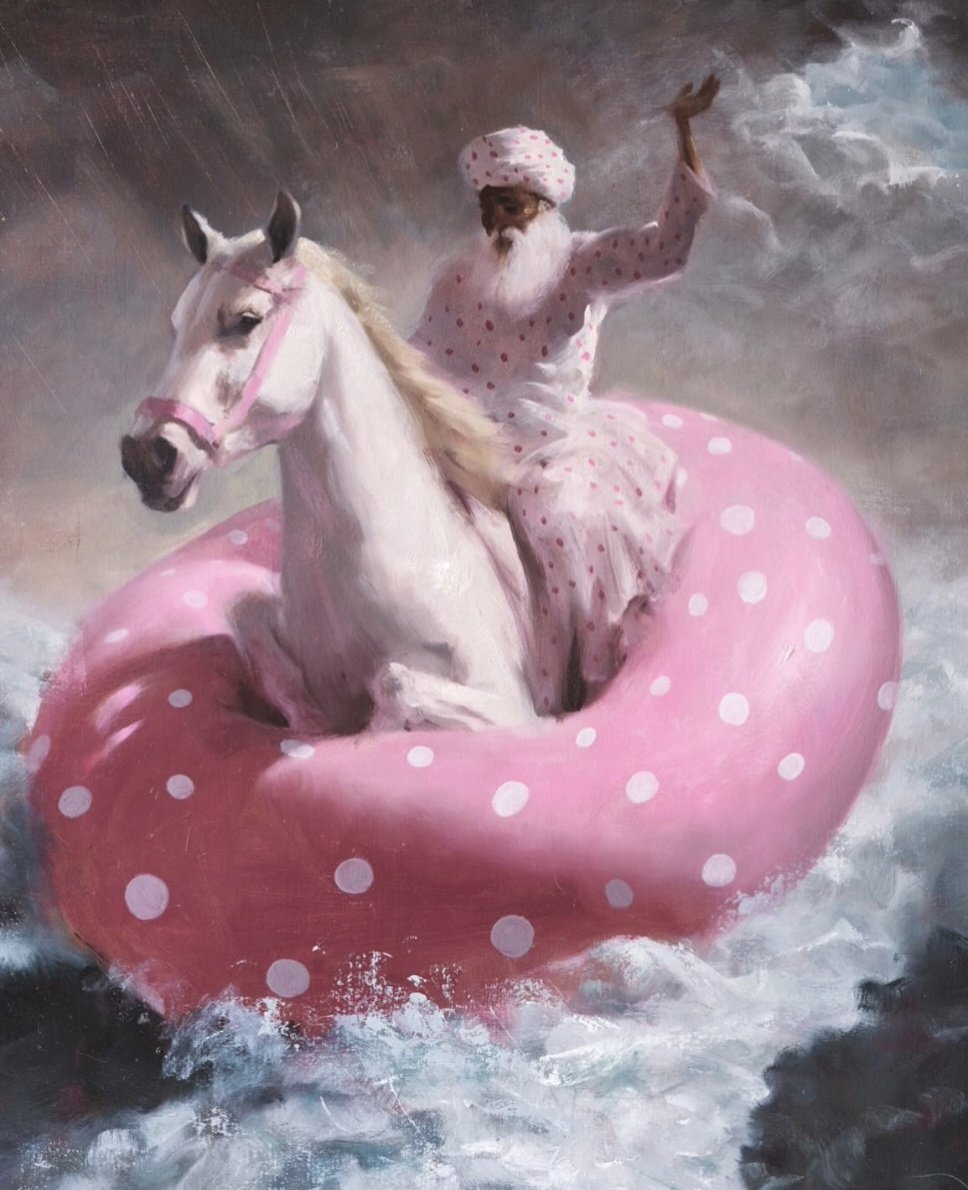
Darvish — Mullah in Exile
NYC
Darvish describes himself as a “Sufi school drop-out,” and that single phrase explains a great deal. His work grows out of a spiritual tradition but refuses to submit to its rigid rules. He preserves symbols, archetypes, and the weight of established meanings, only to gently subvert them. Under his brush, authority becomes fragile, holiness becomes human, and certainty is replaced by a tender ambiguity. These are not paintings about faith as a doctrine; they are paintings about internal survival. Darvish’s figures often seem suspended or displaced, as if existing between worlds. They are not heroes in the classical sense, but rather witnesses—observers of chaos rather than its conquerors. Today, his works are exhibited in New York, but emotionally, they belong everywhere.
"Mullah in Exile" stopped me in my tracks immediately. A religious figure—usually associated with gravity, discipline, and authority—drifts through a storm on a pink inflatable ring. The image is almost absurd, light, and disarming, yet the storm is real. The waves are aggressive, and the sky is heavy. Nothing here promises safety or control; there is only the act of staying afloat despite the tempest.
I don’t know how you’ve been feeling lately, but I have been feeling overwhelmed—not in a dramatic way, but in a quiet, persistent way, the way life can pile up until your breath becomes shallow. When I saw this painting, I thought: this is exactly what I need right now. Not an escape, not a denial, but simply the possibility of an inhale and an exhale in the very middle of the chaos. This image redefines resilience. It suggests that strength doesn't always mean resistance; sometimes it means lightness. It is the refusal to sink even when conditions are brutal. It is the permission to embrace something soft, perhaps even a bit ridiculous and pink, without any shame.
There is something deeply radical in this. The Mullah does not fight the storm. He does not try to dominate it. He doesn't pretend it isn't there. He floats. He adapts. He allows the storm to carry him instead of letting it drown him. Perhaps that is where the quiet wisdom of this painting lies. I think it is one of the hardest skills in life: to remain open, breathing, and somehow kind when everything around you is loud and heavy—to use the force of the storm to move forward instead of sinking within it. This image leaves me with a question that lingers: can we maintain a sense of lightness—not a naive or detached one, but a buoyant one—when life turns into a storm? Sometimes, that feels like the bravest thing we can do.
